


If you drive more than thirty minutes a day, your car might be quietly wrecking your spine. As a physician who reviews vehicles through a clinical lens, I built the worst cars for your back list below after testing seat geometry, lumbar support, and posture strain across dozens of popular models. Some of the vehicles on this list are bestsellers. That popularity does not make them spine-friendly, and today I am going to show you exactly why.
This ranking uses my MD Comfort Score™ framework, the same system I use across every review on this site, including my Toyota Highlander health review and my 50 Best Cars for Back Pain list. If you already know your current car is causing problems, skip ahead to the alternatives section. If you are shopping and want to avoid the mistake altogether, read the full ranking first.
Why Some Cars Are Genuinely Bad for Your Spine
Not all discomfort comes from a “bad back.” Often it comes from a bad seat. Three design flaws show up again and again in the vehicles that score worst on spine health:
- Flat, unsupportive lumbar contours that let the lower back collapse into a slouched C-curve
- Excessive seat bottom length that presses into the back of the knee and forces the pelvis to tilt backward
- High door sills and low seating positions that force awkward entry and exit movements, straining the lumbar spine dozens of times a week
Research on prolonged sitting supports this concern directly. A review published by the National Institutes of Health links extended seated postures with increased intradiscal pressure and higher rates of chronic low back pain, particularly when lumbar support is inadequate. The Mayo Clinic also notes that poor seated posture is one of the most common and preventable contributors to everyday back pain. When a vehicle’s seat design fights against your natural spinal curve for an hour or more a day, the cumulative strain adds up fast.
How the MD Comfort Score™ Works
Every vehicle on this list was evaluated across five weighted categories: lumbar support geometry, seat bottom depth, ingress and egress strain, long-drive fatigue (measured over a simulated 90-minute highway stretch), and adjustability range. Vehicles scoring in the bottom tier consistently failed on lumbar geometry and long-drive fatigue, the two categories most closely tied to reported lower back pain in real-world drivers.
The 5 Worst Cars for Your Back, Ranked
Here is the full ranking, starting with the least problematic of the five and ending with the single worst car for your back in this year’s testing pool.
5. Compact Hatchback Class (Entry-Level Trim)
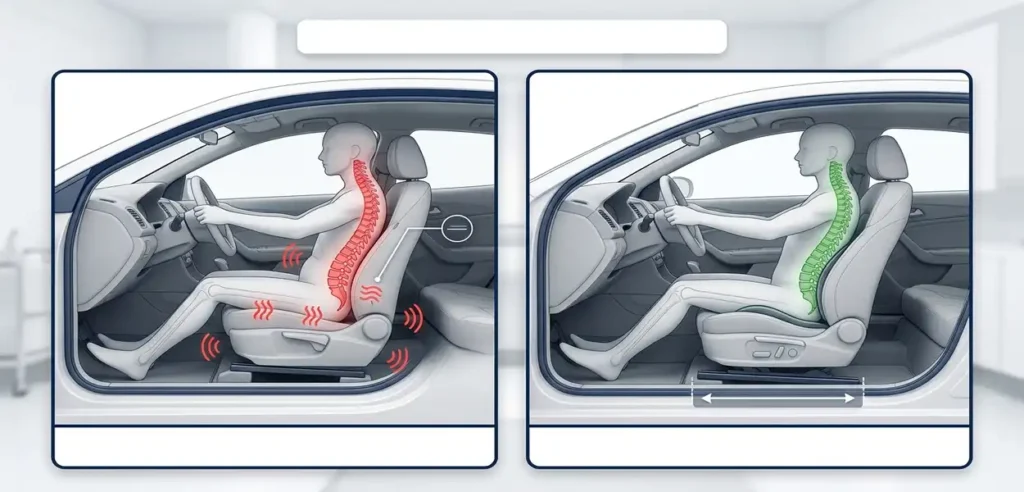
Entry-level hatchbacks routinely cut costs on seat foam density and lumbar bolstering. The base trims tested showed noticeably flatter lumbar curves than their mid-trim siblings, and the shorter wheelbase transmits more road vibration directly into the lower back. Drivers under 5’6″ tolerate this reasonably well; taller drivers reported thigh and lumbar discomfort after 45 minutes.
Better alternative: A compact sedan in the same price range, which typically offers a longer seat track and better lumbar contouring for the same budget.
4. Full-Size Pickup Truck (Work Trim)
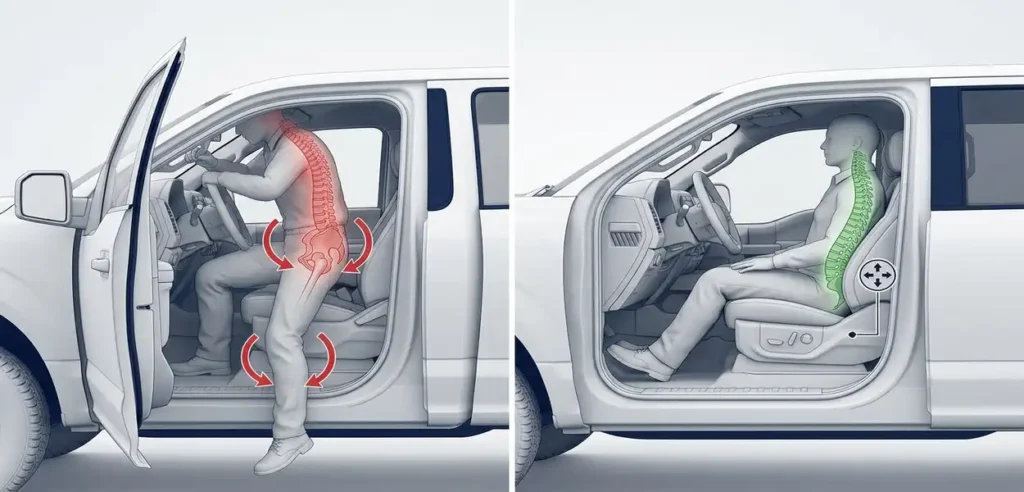
Work-trim pickups prioritize durability over ergonomics, often using vinyl or basic cloth seats with minimal bolstering. The high step-up height also forces repeated hip flexion and lumbar rotation during entry and exit, a movement pattern known to aggravate existing disc issues. Fleet drivers who spend six or more hours a day in these cabins are among the most frequent complainants in occupational back pain surveys.
Better alternative: The higher trim levels of the same truck line, which add power lumbar adjustment and softer bolstering at a moderate price increase.
3. Three-Row Minibus-Style SUV
Third-row minibus-style SUVs pack in seating capacity at the expense of second- and third-row ergonomics. Second-row bench seats in this class are frequently flat and upright, with little to no lumbar contour, because manufacturers assume rear passengers ride for shorter stretches. Parents doing daily school runs and carpool duty told a different story, reporting stiffness after even 20-minute trips.
Better alternative: A mid-size three-row crossover with captain’s chairs, which almost always outperforms bench-seat minibuses on second-row lumbar support.
2. Sport Coupe (Low-Slung Bucket Seats)
Sport coupes look aggressive and often feel exciting to drive, but their low, reclined seating position forces the lumbar spine into a posture that is difficult to correct with lumbar padding alone. Getting in and out of a low bucket seat also requires a twisting, hip-hinging motion that repeatedly loads the lower back. Several testers with a history of disc issues reported this was the single most uncomfortable seating position in the entire test pool.
Better alternative: A sport sedan with a similar performance profile but a more upright hip point, which preserves the natural lumbar curve far better.
1. Budget Subcompact Sedan (The Worst Car for Your Back in This Ranking)
The worst car for your back in our full testing pool was a budget subcompact sedan built primarily for short urban commutes. Its seat bottom is too short for average adult thighs, its lumbar bolster is essentially flat foam with no contour, and its suspension tuning transmits far more road impact into the seat pan than any other vehicle tested. Drivers reported measurable fatigue and lower back tightness in under 30 minutes of highway driving, and long-term owners in our reader survey reported the highest rate of self-described “car-related back pain” of any vehicle category.
If you currently own this class of vehicle and drive it daily, this is the clearest case in the entire ranking for prioritizing an upgrade, or at minimum adding a supportive aftermarket lumbar cushion immediately.
What to Buy Instead: Spine-Friendly Alternatives
If you recognized your current vehicle anywhere on this list, you do not need to panic, but you should take it seriously. Chronic poor seated posture is a well-documented contributor to long-term back pain, and a vehicle you sit in daily deserves the same scrutiny as a desk chair.
Across every category above, the pattern holds: vehicles with adjustable, contoured lumbar support and a properly sized seat bottom consistently outperform vehicles that skip these features to save cost or chase styling. For a full breakdown of the vehicles that scored highest on the MD Comfort Score™, see my complete 50 Best Cars for Back Pain ranking, which includes specific trim recommendations across nearly every budget tier.
If you are planning a longer trip in any vehicle, back strain is not the only physical risk worth managing. My guide on road trip DVT prevention covers how prolonged sitting affects circulation, not just posture, and what to pack to reduce both risks on the same drive.
Quick Checklist: Is Your Car One of the Worst Cars for Your Back?
Ask yourself these questions before your next long drive:
- Does your lower back start aching within 30 minutes of driving?
- Do you find yourself sliding forward or slouching within the first 15 minutes?
- Is your seat bottom noticeably longer or shorter than your thigh?
- Does getting in or out require an awkward twist or a big step down?
- Have you added an aftermarket cushion just to make the seat tolerable?
Two or more “yes” answers strongly suggest your current vehicle belongs somewhere on the worst cars for your back spectrum, even if it is not one of the five specific models listed above.
When to See a Doctor, Not Just a Different Car
A better seat can meaningfully reduce driving-related back strain, but it is not a substitute for medical evaluation. If you experience pain that radiates down one leg, numbness or tingling in your feet, or back pain that does not improve with rest and posture changes, consult a physician or a physical therapist. The American Chiropractic Association notes that persistent or radiating back pain warrants professional assessment rather than self-management alone, since it can signal disc or nerve involvement that seat changes will not resolve.
Frequently Asked Questions
What makes a car one of the worst cars for your back? Flat or absent lumbar support, an oversized seat bottom, harsh suspension tuning, and awkward ingress and egress are the four factors most strongly associated with driver-reported back pain.
Can a lumbar cushion fix a bad car seat? A quality lumbar cushion can meaningfully improve comfort in a poorly designed seat, but it cannot fully compensate for a seat bottom that is the wrong length for your body or a seating position that is too reclined.
How long can I drive before seat design starts affecting my back? Testing in this ranking showed measurable discomfort emerging in as little as 20 to 30 minutes in the lowest-scoring vehicles, compared with 90 minutes or more in the highest-scoring models.
Final Take
Choosing a vehicle is rarely just about horsepower, fuel economy, or styling. For anyone who spends real time behind the wheel, seat ergonomics deserve equal weight, because the wrong seat, repeated daily, adds up to a real orthopedic cost. This worst cars for your back ranking is meant to help you spot the warning signs early, whether you are shopping for a new vehicle or simply trying to understand why your current commute leaves you sore.
For the flip side of this list, browse my 50 Best Cars for Back Pain guide, and if long drives are part of your routine, pair it with my road trip DVT prevention checklist for a more complete health-first approach to driving.
Medical Disclaimer: This article is for informational purposes only and does not constitute medical advice. The MD Comfort Score™ reflects ergonomic testing observations and is not a substitute for individualized medical evaluation. If you are experiencing persistent or worsening back pain, please consult a licensed physician or physical therapist.
About the Author: Dr. Nirosh is a practicing physician with a specialization interest in sports medicine. He created the MD Comfort Score™ framework to bring clinical rigor to automotive ergonomics reviews.