


By Dr. Nirosh, MBBS
Most car seats fail your spine within the first thirty minutes of a drive. Automakers spend fortunes on infotainment screens and horsepower, yet they rarely engineer a seat that matches the natural curve of your lower back. That’s where car lumbar support cushions come in. As a doctor who evaluates vehicles through a medical lens every day, I test lumbar cushions the same way I assess any car’s Clinical Vitals Score: I look at spinal alignment, pressure distribution, and how well a product holds up over hundreds of highway miles.
This guide walks you through the best car lumbar support cushions on the market right now, explains the clinical reasoning behind why your back hurts after driving, and shows you exactly how to choose and position a cushion so it actually helps instead of making things worse. If you already read our 50 Best Cars for Back Pain ranking think of this article as the accessory companion: the fix you can buy today, regardless of what you currently drive.
Why Your Car Seat Causes Lower Back Pain
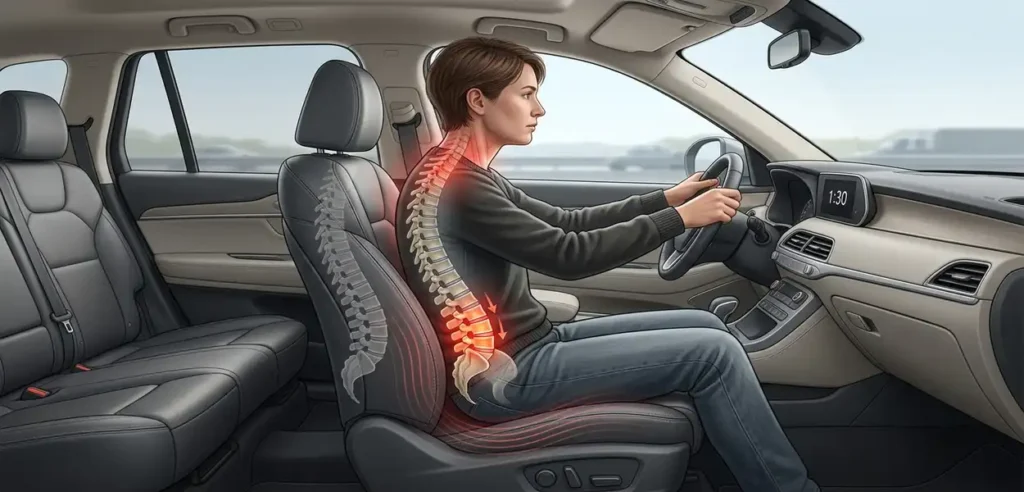
Your lumbar spine has a natural inward curve called lordosis. When you sit in a flat or unsupportive car seat, that curve flattens out, and your spinal discs bear far more pressure than they do when you stand. Add vibration from the road, a fixed position for an hour or more, and tense shoulders from traffic, and you have a near-perfect recipe for lower back strain.
Researchers have measured this directly. A controlled study published through the National Institutes of Health found that a contoured lumbar support pillow measurably improved lumbar posture and reduced discomfort scores during a prolonged seated task compared with a standard, unsupported chair back. Occupational health trials on professional drivers echo the same finding: combining postural training with dedicated lumbar support reduces reported back pain more than posture training alone. Your body genuinely responds to proper lumbar support — this isn’t just marketing.
If you drive an older vehicle, a base trim without adjustable lumbar support, or a rental car on a long trip, a portable cushion becomes your fastest fix. Even in vehicles that already ship with built-in lumbar adjustment, like the Volvo EX60 we reviewed in our Volvo EX60 Health Review, many drivers still need supplemental support because factory settings rarely account for shorter or taller torsos.
How I Evaluate the Best Car Lumbar Support Cushions

I don’t rank cushions by star ratings alone. I score every product against the same clinical framework I use for full vehicle reviews:
- Spinal contour match. Does the curve of the cushion actually sit against the lumbar region, or does it push against the mid-back and force you to arch?
- Firmness and density. Too soft, and the cushion collapses under body weight within a week. Too firm, and it creates a pressure point instead of relieving one.
- Strap and retention system. A cushion that slides down during braking or acceleration does nothing for your posture and becomes a driving distraction.
- Breathability. Sri Lankan and tropical climates especially punish thick foam cushions that trap heat against your back.
- Portability. Can you move it from your daily driver to a rental car or your office chair without hassle?
- Durability under real driving conditions, not just a showroom test sit.
I weigh these factors the same way our team builds every MD Comfort Score, and I apply them consistently across every product below.
Top Car Lumbar Support Cushions for Back Pain Relief
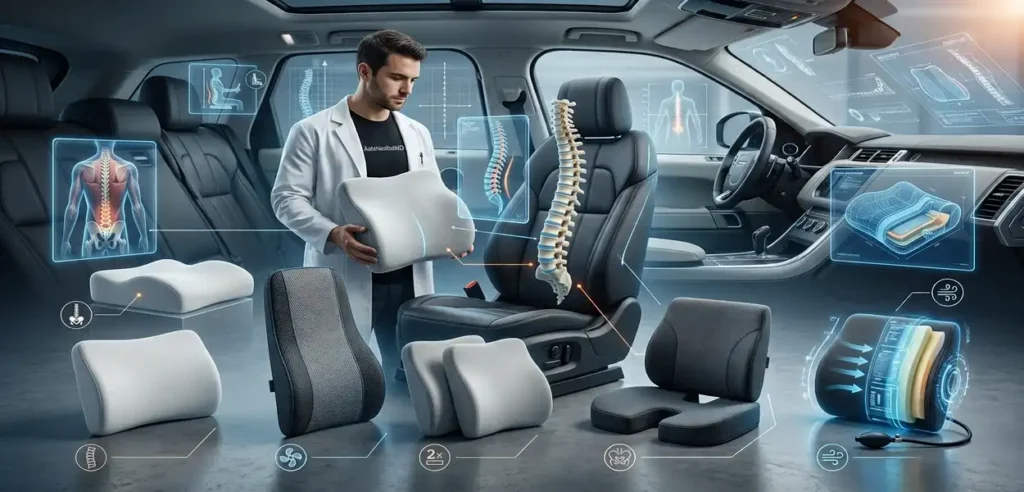
Best Overall: Memory Foam Contour Cushions
The strongest all-around performers use high-density memory foam shaped into a defined lumbar curve, paired with a mesh or breathable fabric cover and an adjustable elastic strap system. This category consistently scores highest on my clinical framework because the foam holds its shape over months of daily commuting instead of flattening out like basic fiberfill pillows. Look for a foam density in the medium-firm range; it should resist a full hand-press without feeling rigid against your spine.
Best for Long-Torso or Taller Drivers
Standard lumbar cushions run roughly 12 to 14 inches tall, which leaves taller drivers unsupported at the mid-back. Elongated cushions, closer to 18 to 21 inches, extend coverage from the pelvis up through the thoracic spine. If you’re over 6 feet tall or drive a vehicle with a more upright seatback, such as a pickup or minivan, prioritize this category over a standard-size cushion.
Best Budget Option: Dual-Pack Foam Cushions
Several manufacturers sell two cushions in a single package at a price close to a single premium cushion elsewhere. This works well if you split time between two vehicles or want a backup for a partner’s car. Budget cushions typically use a lower foam density, so expect to replace them sooner, but they remain a reasonable entry point if you’re testing whether lumbar support helps your specific pain pattern before investing in a premium product.
Best for Hot Climates: Breathable Mesh Cushions
If you drive without air conditioning for long stretches, or you live somewhere humid, prioritize a cushion with a ventilated mesh cover over solid PU leather. Trapped heat and moisture against your lower back don’t just feel unpleasant — they can encourage you to slouch away from the cushion entirely, defeating its purpose.
Best for Sciatica and Tailbone Pain
Drivers managing sciatica or tailbone discomfort often need a combination product: a lumbar cushion for the lower back paired with a cutout seat cushion underneath. The cutout relieves direct pressure on the tailbone and sacrum while the lumbar piece maintains spinal curve. Treat this as a two-part system rather than expecting a single lumbar pillow to solve both problems.
Best Premium Pick: Adjustable Firmness Systems
A small number of premium brands, including well-known mattress companies that have extended into seating support, sell lumbar cushions with dual-density foam layers or adjustable air chambers. These cost more, but they let you fine-tune firmness across seasons or as your pain pattern changes. If back pain significantly limits your driving comfort, this category tends to deliver the best long-term value despite the higher upfront cost.
Lumbar Cushions for Rideshare, Delivery, and Professional Drivers
If you spend six or more hours a day behind the wheel, you face a fundamentally different risk profile than someone with a 20-minute commute. Occupational health research on professional drivers consistently links prolonged, uninterrupted sitting with a higher prevalence of chronic low back pain compared with the general working population. For rideshare, taxi, and delivery drivers, I recommend a slightly different approach than for casual commuters:
- Choose durability over plushness. A cushion that compresses in three months isn’t cost-effective when you’re sitting on it for 250-plus days a year. Prioritize higher-density foam even if it feels firmer during the first week.
- Pair a lumbar cushion with a seat cushion underneath. Professional drivers face tailbone and hip pressure in addition to lumbar strain, so a combination approach protects more of the lower body over a full shift.
- Build in movement breaks between rides or deliveries, not just at the end of a shift. Two minutes of standing and stretching every hour matters more cumulatively than one long break at the end of the day.
- Rotate cushions between vehicles if you drive different cars for work, rather than leaving support to chance in whichever vehicle you’re assigned.
Professional drivers who combine a proper lumbar cushion with scheduled movement breaks report meaningfully less end-of-shift pain than those who rely on the cushion alone. Treat the cushion as one part of a broader routine, not a complete fix.
Lumbar Support During Pregnancy or Post-Surgery Recovery
Pregnant drivers and anyone recovering from spinal or abdominal surgery need a more cautious approach to lumbar cushions. Growing abdominal weight shifts your center of gravity forward and changes how your spine curves while seated, so a cushion sized for a pre-pregnancy body may sit in the wrong place by the second or third trimester. Reassess your cushion’s position every few weeks rather than assuming a single setup works for the entire pregnancy.
If you’re recovering from back surgery, a herniated disc, or another spinal procedure, don’t select a lumbar cushion on your own. Bring the product to your physiotherapist or spine specialist and have them confirm the firmness and shape align with your specific recovery stage. The wrong cushion can push a healing disc in the wrong direction, even if it feels comfortable in the short term.
Common Mistakes That Reduce a Lumbar Cushion’s Effectiveness
Even a well-chosen cushion underperforms if you make one of these common errors:
- Buying based on brand name alone. A well-known mattress brand doesn’t guarantee the car-specific version fits your seat geometry. Check the actual dimensions and strap system, not just the logo.
- Skipping the break-in period. New memory foam often feels firmer for the first several drives before it softens to its intended density. Give a cushion at least a week before deciding it doesn’t work for you.
- Leaving the cushion in a hot car. Direct sun exposure through the windshield degrades foam faster than normal use. Store your car with a windshield shade if you park outdoors regularly, especially in tropical climates.
- Using the same cushion for wildly different seat types. A cushion that fits your sedan’s bucket seat may sit incorrectly in a bench seat or a minivan’s captain’s chair. Reassess fit whenever you switch vehicles.
- Ignoring pain that changes character. Muscular soreness that improves with a cushion is different from sharp, radiating, or numbness-associated pain. The second category needs a medical evaluation, not just a better cushion.
How to Choose the Right Lumbar Cushion for Your Car Seat
Buying the wrong size or shape is the single biggest reason people give up on lumbar cushions after a week. Work through these four questions before you buy.
1. What shape is your current lumbar gap?
Sit in your normal driving position and slide your hand behind your lower back. A large gap means you likely need a thicker, more structured cushion. A shallow gap suggests you only need a slim, low-profile pad.
2. Does your seat have a headrest post or seatback frame that accepts straps?
Most cushions attach with elastic straps that loop around the seatback. Bucket seats in sports cars and some SUVs have unusual frame shapes, so check strap compatibility before you order, especially with older vehicles.
3. How much space do you have between your back and the seat when reclined?
If you recline your seat significantly for long drives, you need a slimmer cushion. A bulky cushion combined with a heavy recline pushes your hips forward and undermines the support it’s supposed to provide.
4. Do you need washable or wipeable materials?
If you eat in the car, drive kids around, or live somewhere hot and humid, a removable, machine-washable cover saves you from replacing the entire cushion when it gets dirty.
How to Position a Lumbar Cushion Correctly
A cushion only works if you place it correctly, and I see this mistake constantly. Follow this sequence every time you install or reposition one:
- Adjust your seat first, before adding the cushion. Set the seatback angle to roughly 100 to 110 degrees and bring the seat close enough that your knees stay slightly bent at the pedals.
- Sit all the way back in the seat so your hips touch the seatback.
- Position the cushion at the natural curve of your lower back, roughly at belt-line height, not higher at your mid-back and not lower at your tailbone.
- Tighten the straps enough that the cushion doesn’t shift when you brake or turn, but not so tight that it bows away from your spine.
- Recheck your mirror and seatbelt fit after installing the cushion, since it changes your seated height slightly.
If you feel pressure concentrated in one specific point rather than distributed support, the cushion sits in the wrong spot or the firmness doesn’t match your body type. Reposition before assuming the product itself is faulty.
Lumbar Cushions vs. Built-In Vehicle Lumbar Support
Newer vehicles increasingly ship with power-adjustable lumbar support, and it’s worth understanding when that factory feature is enough on its own. In our Toyota Highlander Health Effects review, the factory lumbar adjustment performed well for average-height drivers but still left taller passengers wanting more depth. In our Honda CR-V Health Review, we found the base trim lacked adjustable lumbar support entirely, which makes an aftermarket cushion close to essential if you drive that trim regularly.
Built-in lumbar support adjusts the seat’s internal structure, so it generally distributes pressure more evenly across a wider area than an external cushion can. But it can’t be moved between vehicles, and many systems only adjust depth, not height. If factory lumbar support doesn’t fully resolve your discomfort after a week of consistent use, layering a slim external cushion on top usually solves the remaining gap rather than replacing the built-in feature entirely.
Other Ways to Protect Your Back on Long Drives
A lumbar cushion solves one part of the equation, but long drives create other risks worth addressing together. Prolonged sitting also raises your risk of deep vein thrombosis on multi-hour trips, which we cover in detail in our Road Trip DVT Prevention guide. Pair your lumbar cushion with these habits for the best results:
- Take a movement break at least every 90 minutes, even a five-minute walk around a rest stop.
- Adjust your headrest so it supports the middle of your skull, not your neck, to reduce upper spine strain.
- Strengthen your core and hip flexors outside the car; a stronger core reduces how much load your spine carries during long sits.
- Rotate or replace your cushion every 12 to 18 months, since foam density degrades with heat exposure and repeated compression.
Frequently Asked Questions
Do car lumbar support cushions actually work? Yes, for most people. Clinical research shows that a contoured lumbar cushion improves seated posture and reduces discomfort compared with sitting unsupported. Results vary based on your specific pain cause, so if pain persists despite consistent use, see a physician or physical therapist for an evaluation.
Can a lumbar cushion make back pain worse? It can, if the size or firmness doesn’t match your body. A cushion placed too high pushes you into an exaggerated arch, and one that’s too firm creates a new pressure point. Reposition or size down before assuming lumbar support isn’t right for you.
How long does a car lumbar cushion last? Expect 12 to 18 months of daily use from a quality memory foam cushion before the foam compresses enough to lose meaningful support. Budget cushions with lower-density foam may need replacement sooner.
Do I need a lumbar cushion if my car already has adjustable lumbar support? Not always, but many factory systems only adjust depth and don’t account for torso height. If you still feel unsupported after adjusting the built-in feature fully, add a slim external cushion rather than assuming your car simply isn’t a good fit for your body.
Memory foam or gel: which material is better for a car lumbar cushion? Memory foam holds its contoured shape longer and provides firmer structural support, which makes it the better choice for most drivers dealing with genuine lumbar pain. Gel cushions distribute pressure well and stay cooler in hot climates, but they compress faster under sustained use and suit shorter drives or milder discomfort better than chronic pain relief.
Can I use a home or office lumbar cushion in my car instead of buying a car-specific one? You can, but car-specific cushions account for the more upright seatback angle and tighter clearance of a vehicle seat, while office cushions are often sized for a taller chair back. If you already own a lumbar pillow you like, test it in your car seat before buying a dedicated one; just confirm the straps fit your seatback frame.
The Bottom Line
Back pain from driving isn’t something you have to accept as a cost of your commute. A properly fitted lumbar support cushion, placed correctly and matched to your body type, measurably improves seated posture and reduces the strain that builds up over a long drive. Start with your specific pain pattern and torso height, choose a cushion category from the picks above, and give it two full weeks of consistent use before judging whether it’s the right fit. And if you’re shopping for a new vehicle altogether, revisit our 50 Best Cars for Back Pain ranking to see which models give your spine the best starting point before you even add a cushion.
Medical Disclaimer: This article is for informational purposes only and does not constitute medical advice. Auto Health Review MD content reflects general ergonomic and orthopedic principles and should not replace a consultation with your physician, especially if you experience persistent, severe, or worsening back pain, numbness, or weakness. Auto Health Review MD may earn a commission from qualifying purchases through affiliate links, which does not influence our reviews or recommendations.
Dr. Nirosh, MBBS Founder, Auto Health Review MD