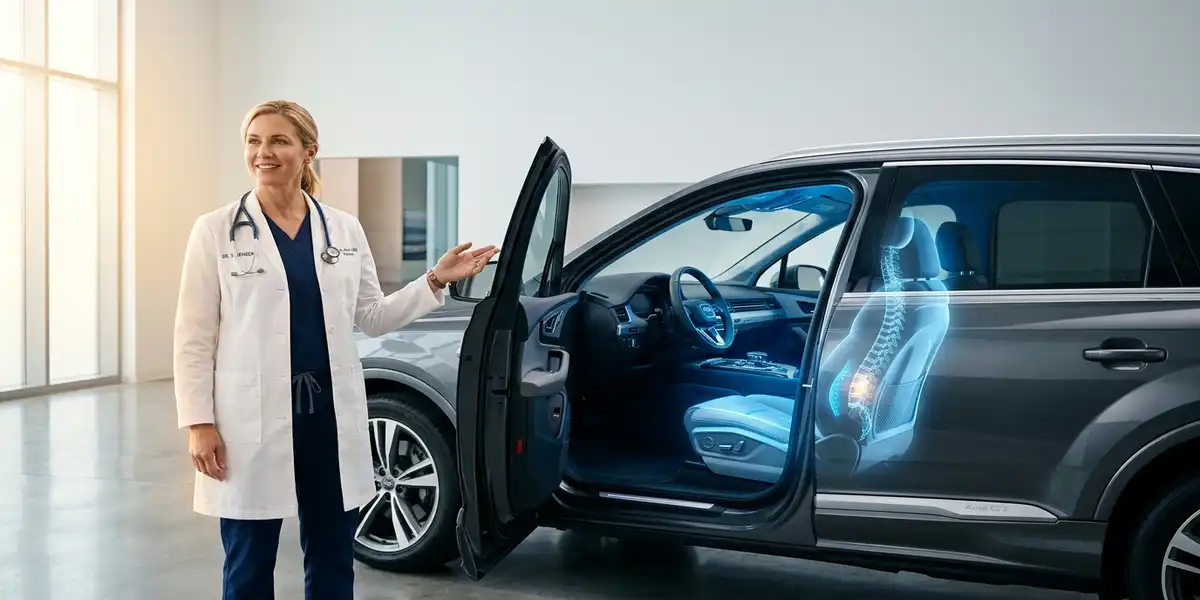


I award every vehicle an MD Back Comfort Score out of 100 across six weighted domains.
| Domain | Weight | What I measure |
|---|---|---|
| Lumbar support system | 25 | Adjustment axes, range, height positioning, on-the-move control |
| Seat base geometry | 20 | Cushion length, thigh support, base tilt, bolster aggression |
| Vibration isolation | 20 | Suspension tuning, wheel and tyre sidewall, seat frame damping |
| Entry and exit | 15 | Hip point height, sill width, door aperture, grab points |
| Driving position alignment | 10 | Wheel reach and rake, pedal offset, mirror sightlines |
| Long-drive endurance features | 10 | Massage, memory settings, cushion extension, seat ventilation |
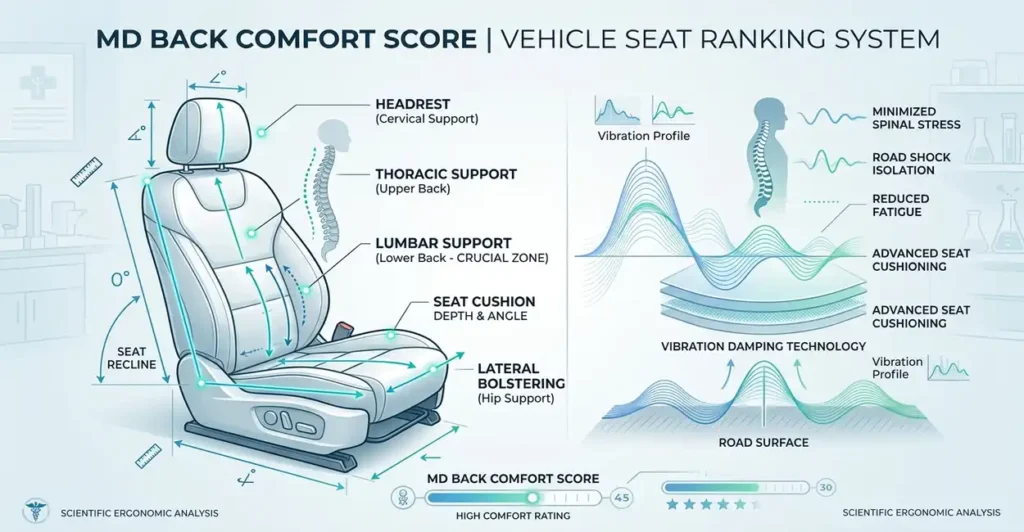
A score above 85 marks a vehicle I recommend confidently to patients with established spinal pain. Anything below 70 receives a warning, however good it looks.
Two Patient Stories That Shaped How I Judge the Best SUV for Back Pain
Clinical experience corrects theory. Two consultations changed my scoring permanently.
The sales rep who fixed his back by changing cars
A regional sales representative came to me with two years of worsening lower back pain. He drove roughly 3,000 kilometres each month in a low, sporty sedan with fixed lumbar foam and 19-inch wheels. Imaging showed early degenerative change at L5–S1 — real, but modest. His pain far exceeded his scan.
We addressed the obvious things first. Physiotherapy helped a little. Then he changed vehicles, moving into a mid-size SUV with four-way power lumbar support, an extendable cushion and taller tyre sidewalls. He reported roughly half his previous pain within six weeks, and he stopped needing anti-inflammatories on long routes. His disc did not change. His daily posture and vibration exposure did.
The patient whose bigger SUV made sciatica worse
A second patient taught me the opposite lesson. She bought a large three-row SUV specifically because a friend recommended it for back trouble. Her sciatica intensified within a month.
The seat itself scored well. The problem sat in the doorway. Entering the vehicle demanded a climb, a rotation and a reach, and she performed that combined movement eight or ten times daily. Rotating a loaded lumbar spine under tension irritates a compressed nerve root reliably. She moved to a smaller crossover with a lower sill and a wider door aperture, kept her seat settings almost identical, and her leg pain settled.
That case is why entry and exit carries 15 points in my scoring, and why the easiest SUV to get in and out of with back pain often beats the plushest seat on paper.
The 15 Best SUVs for Back Pain and Sciatica in 2026
| # | Vehicle | MD Back Comfort Score | Lumbar adjustment | Standout strength |
|---|---|---|---|---|
| 1 | Volvo XC90 | 94/100 | 4-way power + cushion extension | Orthopaedic seat architecture |
| 2 | Volvo XC60 | 92/100 | 4-way power | Same seats, easier entry height |
| 3 | Mercedes-Benz GLE | 91/100 | Multicontour + massage | Active pressure redistribution |
| 4 | Genesis GV80 | 89/100 | Ergo-motion 7-way | Micro-adjusts posture on long drives |
| 5 | Volkswagen Tiguan | 87/100 | 14-way ErgoActive | Independently certified seat design |
| 6 | Toyota Highlander | 87/100 | 4-way power | Excellent vibration isolation |
| 7 | Kia Telluride | 86/100 | 4-way power | Flat sill, generous aperture |
| 8 | Honda CR-V | 86/100 | 4-way power (upper trims) | Ideal hip point for most adults |
| 9 | Hyundai Santa Fe | 85/100 | 4-way power | Square door opening |
| 10 | Subaru Forester | 85/100 | 2-way power | Upright posture, huge glass area |
| 11 | Mazda CX-60 | 84/100 | 2-way power | Seat designed around spinal S-curve |
| 12 | Toyota RAV4 | 83/100 | 2-way power | Dependable all-round geometry |
| 13 | Kia Sportage | 82/100 | 2-way power | Strong value with real support |
| 14 | Subaru Crosstrek | 79/100 | Manual | Lowest-effort entry in the group |
| 15 | BYD Sealion 7 | 78/100 | 2-way power | Quiet cabin, firm supportive base |
Best SUV for Back Pain Overall: Volvo XC90, XC60 and Mercedes-Benz GLE
Volvo earns the top two positions, and the reason runs deeper than luxury. The company has developed its seat architecture with spinal specialists for decades, and the results show in measurable detail: a lumbar apex that sits where adult lumbar spines actually curve, four-way powered adjustment, and a cushion that extends to support the full length of your thigh. That last feature matters enormously on long drives, because unsupported thighs shift load back onto your pelvis and lumbar spine.
The XC60 deserves special mention. It shares the seats with the XC90 while sitting lower, so patients who struggle with high sills reach it more easily. For many of my patients, the XC60 represents the genuine sweet spot.
The Mercedes GLE brings multicontour seats with active massage. Cyclical pressure redistribution addresses the real enemy on a five-hour drive — sustained static loading of one tissue region. This ranks among the most comfortable SUV options for a bad back that money currently buys, and I say that as a clinician, not an enthusiast.
Best SUV with Best Lumbar Support Under Premium Money
The Volkswagen Tiguan punches far above its price. Volkswagen submits its ErgoActive seats to independent back-health certification by Germany’s Aktion Gesunder Rücken, an organisation of physiotherapists and physicians that assesses products for spinal ergonomics. Very few carmakers accept that scrutiny. The 14-way adjustment with pneumatic lumbar and massage delivers genuine clinical value, and the Tiguan therefore offers arguably the best SUV seats for back pain in the mainstream segment.
Mazda deserves recognition alongside it. Mazda engineers its seats explicitly around maintaining the natural S-curve of the spine and keeping the pelvis upright, and the CX-60 demonstrates the philosophy well. The 2-way lumbar limits the score, but the underlying geometry impresses me.
Best Mid-Size SUV for Back Pain and Sciatica
The Toyota Highlander, Kia Telluride and Hyundai Santa Fe form a strong trio. The Highlander isolates road vibration beautifully, which addresses the whole-body vibration risk discussed above. The Telluride and Santa Fe both offer squared-off door openings that let you sit down and swing in rather than climbing and twisting — the movement pattern my sciatica patients tolerate best.
Choose the smallest wheel option your trim allows. A Telluride on 18-inch wheels rides measurably calmer than the same vehicle on 20s.
Best SUV for Lower Back Pain in the Compact Class
The Honda CR-V leads here, and its hip point explains why. The CR-V places your hips at a height that suits most adults between 155 cm and 190 cm, so you neither drop into the seat nor climb up to it. Both extremes provoke pain. Add four-way power lumbar on upper trims and the CR-V becomes the compact I recommend most often.
The Subaru Forester follows closely with an upright posture and exceptional visibility, which reduces neck rotation — an underrated factor when cervical and lumbar symptoms coexist. The RAV4 and Sportage both deliver honest, well-judged geometry at accessible prices.
Easiest SUV to Get In and Out of With Back Pain
The Subaru Crosstrek scores 79 overall, held back by manual-only lumbar adjustment, yet I still send certain patients straight to it. Its sill sits low, its aperture opens wide, and it demands the least spinal rotation of any vehicle here.
My second patient story explains the logic. When entry movements provoke your symptoms, entry geometry outranks seat luxury. Buyers in Asian markets should also consider the Honda Vezel, which delivers similar ease of access, and the Hyundai Venue N Line for tighter budgets, though its firmer sports tuning suits some spines better than others.
Best Electric SUV for Sciatica
Electric SUVs bring a genuine advantage and a genuine trap. The advantage: no engine vibration and a lower noise floor, which reduces the muscle tension that amplifies pain perception. The trap: battery packs sit under the floor, raising your hip point relative to the roof and often forcing a knees-up seating position — precisely the deep hip flexion that aggravates radicular pain.
The BYD Sealion 7 manages the compromise reasonably with a firm, supportive base. The BYD Atto 3 and the Volvo EX60 both deserve a look, and I cover the same trade-off in the Tesla Model 3 health review.
Sit in any electric SUV for 20 minutes minimum before you buy. Check where your knees sit relative to your hips.
Best SUV for Long Distance Driving With Back Pain: Three Rules I Give Patients
Rule one: choose the smallest wheels available. Taller tyre sidewalls absorb vibration your spine would otherwise absorb. Buyers routinely upgrade to larger wheels and then wonder why their back deteriorated.
Rule two: reject sports seats. Manufacturers fit aggressive bolsters to sports trims, and those bolsters compress the gluteal region where your sciatic nerve travels. Comfort trims usually support your back better than the expensive sporty version.
Rule three: move every 90 minutes. No seat replaces movement. Stop, stand, walk for three minutes, and perform gentle lumbar extension. Prolonged immobility also raises venous thromboembolism risk, which I cover fully in our road trip DVT prevention guide.
SUVs I Warn Patients About
I withhold specific model names where trim variation makes a blanket judgement unfair, but I flag four patterns consistently:
- Coupe-roofline SUVs. Sloping rooflines shrink the door aperture and force you to duck and twist on every entry.
- Performance trims on 21-inch or larger wheels. Vibration exposure rises sharply and ride harshness follows.
- Base trims with fixed lumbar foam. A moulded bulge that never adjusts fits almost nobody’s lumbar apex.
- Very low crossovers with short cushions. Short cushions leave your thighs unsupported and drive load into your pelvis.
For a broader picture across body styles beyond SUVs, our ranking of the 50 best cars for back pain in 2026 covers sedans, hatchbacks and MPVs alongside the best car for back pain in each price bracket.
How to Set Up Any SUV Seat for Back Pain and Sciatica
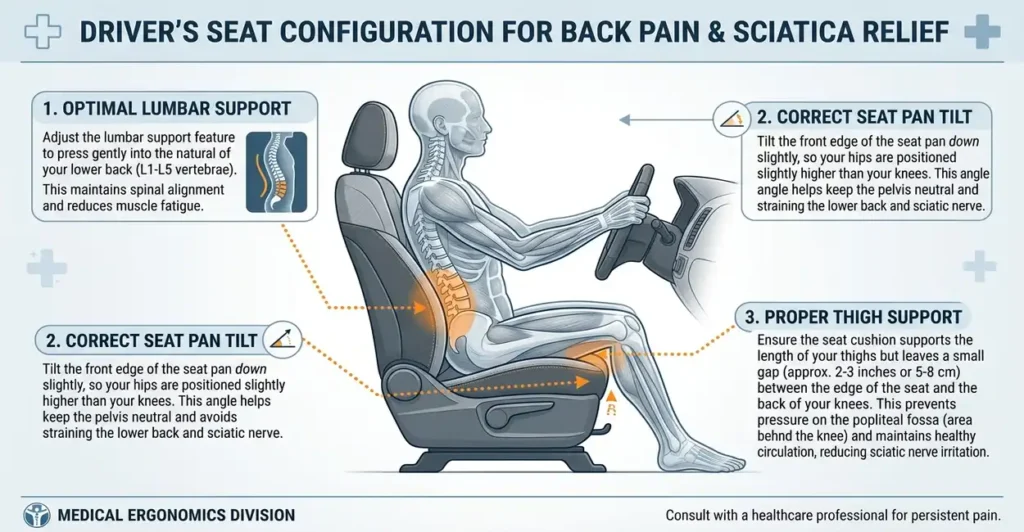
Follow this sequence in order. Most drivers adjust the wheel first, which locks in a poor spinal position.
- Raise the seat height until your hips sit level with or slightly above your knees. Sciatica patients should aim slightly higher.
- Set the base tilt so your thighs rest supported along the full cushion, without pressure behind your knees.
- Recline the backrest to roughly 100–110 degrees, matching the ergonomics evidence above.
- Set the lumbar support to fill the gap at your waistline, then reduce it slightly. Most people over-inflate it.
- Slide the seat so your knee holds a soft bend when the pedal reaches the floor.
- Adjust the steering wheel last, bringing it to you rather than reaching forward to it.
- Empty your back pockets. A wallet under one buttock tilts your pelvis and compresses the sciatic pathway. I have resolved mild sciatica with that single instruction more than once.
If your vehicle lacks proper adjustment, a well-chosen cushion helps meaningfully. Our best car seat cushions for back pain buyer’s guide covers lumbar rolls and wedge cushions I consider clinically sound.
Best SUV for Back Pain FAQ
Does an SUV suit back pain better than a sedan? Usually, yes, for one reason: hip point height. SUVs let you sit down and slide across rather than lowering yourself and folding your hips deeply. That single difference helps most patients with lumbar pain and helps sciatica patients even more.
Which SUV offers the best lumbar support? Volvo’s XC90 and XC60 lead on adjustment range and lumbar apex placement, while the Volkswagen Tiguan offers the strongest independently certified seat design at mainstream money.
Is the best SUV for sciatica the same as the best SUV for lower back pain? Not always. Sciatica responds to reduced nerve tension, which favours a higher hip point and a flatter seat base. Mechanical low back pain tolerates a rearward-tilted base far better. Test drive with your specific symptoms in mind.
Do heated or massaging seats genuinely help? Heat relaxes muscle guarding and helps symptomatically. Massage functions offer more than luxury, because cyclical pressure change reduces sustained static loading. Neither substitutes for correct geometry.
How long should a test drive last? Forty-five minutes minimum, on roads you actually use. Back pain and sciatic symptoms often surface after 30 minutes, long after a standard showroom loop ends.
Written by Dr. Nirosh (MBBS,). Medical disclaimer: This article provides general information about vehicle ergonomics and does not constitute medical advice, diagnosis or treatment. Persistent back pain, radiating leg pain, numbness, weakness, or any change in bladder or bowel control requires urgent assessment by a qualified clinician. Auto Health Review MD may earn a commission from qualifying purchases through affiliate links, which never influences our scoring.