

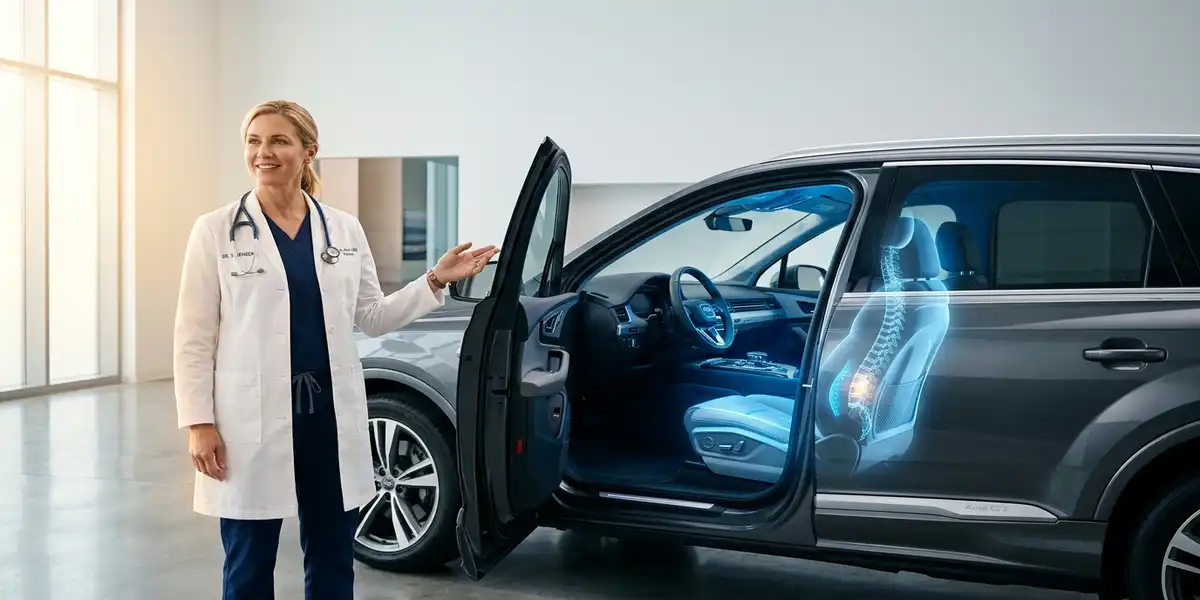
If you live with chronic back pain, the car you drive matters more than most people expect. Working in an orthopaedic unit I see the same pattern repeatedly: a patient managing their lumbar pain reasonably well through exercise and physiotherapy, whose symptoms are being quietly maintained by two hours a day in a seat that works against them.
Driving is rarely part of the conversation. Medication, physiotherapy and exercise are discussed at length; the seat the patient spends ten hours a week in is not. That is a gap worth closing, because the seat is one of the few variables a person can actually change.
This guide ranks 50 vehicles for 2026 using the MD Comfort Score™, a framework built to assess cars on spinal ergonomics rather than performance or styling. Every score below is broken down by category, so you can see exactly where a vehicle earned or lost its points and weigh the categories that matter most for your own condition.
How these vehicles were assessed
Every entry states its assessment method. Vehicles marked assessed in person were evaluated directly, with seat and cabin measurements taken by hand. The remainder were scored from manufacturer seat specifications, published dimensional data and established ergonomic literature. Both are legitimate methods and you are entitled to know which one produced the number you are reading.
The MD Comfort Score is a structured ergonomic rating, not a clinical measurement or a diagnosis. Seat specification also varies by trim and by market, so verify lumbar adjustment, cushion length and seat height on the exact car you are considering rather than on the model name.
Why driving makes back pain worse
Sitting looks passive. Mechanically it is not — though the real picture is more interesting than the version usually repeated online, and worth setting out properly.
The familiar figures come from Alf Nachemson’s intradiscal pressure work in the 1960s, which reported that unsupported sitting raised the load on the lumbar disc by roughly 40 per cent compared with standing. Those numbers are still quoted everywhere. They were also substantially revised. In 1999 Wilke and colleagues implanted a pressure transducer into a healthy L4–L5 disc and recorded directly for about 24 hours. Relaxed standing measured around 0.5 MPa; sitting unsupported measured around 0.46 MPa. Sitting came out slightly lower than standing, not higher.
What the two studies agree on matters more than where they differ. Posture within a position is where the large changes happen. Wilke recorded roughly 0.83 MPa sitting in maximum flexion against 0.46 MPa sitting relaxed — close to double, from posture alone. That is the difference between sitting upright in a supportive seat and slumping toward the steering wheel for an hour.
The finding most relevant to drivers comes from elsewhere. Lis and colleagues reviewed 25 studies of occupations involving prolonged sitting and concluded that sitting on its own was not associated with low back pain. The risk rose significantly when sitting was combined with whole-body vibration and awkward posture, the three acting together rather than any one of them alone.
That combination is a precise description of driving. You are seated, exposed to continuous vibration, and largely fixed in position by the pedals, the wheel and the seatbelt. Bovenzi and Hulshof’s meta-analysis of 22 occupational groups exposed to whole-body vibration found consistent evidence of an association with low back pain, and professional drivers appear repeatedly throughout that literature.
This is why a car seat is worth taking seriously as a clinical variable. It is one of the few places in daily life where all three exposures stack up for hours at a time, and it is also one of the few you can actually change.
Over a sustained drive, several things happen together:
- Disc pressure climbs sharply if the trunk drifts into flexion, which a reclined backrest and a distant wheel both encourage.
- The pelvis rotates backwards, flattening the lumbar curve.
- Hip flexors shorten and the deep core muscles become less active.
- Small postural muscles fatigue and begin to guard.
- Whole-body vibration from the road loads the spinal joints continuously.
- The position barely changes, so no part of the tissue gets a rest.
Vibration is the element drivers underestimate most. The seated body has a whole-body resonance in roughly the 4 to 8 Hz range, close to what a vehicle transmits on a poor road surface, which is why suspension quality is scored here rather than treated as a comfort luxury.
The lack of position change matters nearly as much. Wilke’s own conclusion was that constantly changing position is important for fluid flow into the disc, and a driver strapped into one posture for two hours gets none of it. That is the mechanism behind the advice to break a long journey every 45 to 60 minutes, and it is why a seat with more adjustment beats a seat with more padding.
Patients with sciatica, lumbar disc herniation, degenerative disc disease, facet arthropathy or spinal stenosis commonly describe driving as the most uncomfortable part of their day. The encouraging part is that the differences between vehicles are large enough to be worth choosing between.
How the MD Comfort Score™ works
Each vehicle is scored out of 100 across seven categories. The weighting reflects clinical priority rather than showroom appeal.
| Category | Max points | What it measures |
|---|---|---|
| Lumbar support | 25 | Depth, height and adjustability of lumbar support |
| Seat cushion comfort | 20 | Cushion length, width, density and pressure distribution |
| Ease of entry & exit | 15 | Door aperture, sill height, hip flexion and trunk rotation required |
| Seat height | 15 | Hip height relative to standing, and range of height adjustment |
| Driving position | 10 | Steering reach, pedal placement, backrest angle, control reach |
| Suspension comfort | 10 | Vibration and impact transmitted to the seat base |
| Ride quietness | 5 | Cabin noise and its effect on fatigue and muscle guarding |
| Total | 100 |
Read the subscores, not just the total
Thirty of the hundred points go to seat height and ease of entry, because for most patients the transfer in and out is the single most painful moment of a journey. That weighting means taller vehicles rank higher as a class, and a low saloon cannot reach the top of this table no matter how good its seat is.
If getting in and out is not a problem for you, ignore those two categories and compare the lumbar support and cushion scores instead. On that basis several sedans in the lower half of this ranking will suit you better than crossovers above them. The category breakdown under each vehicle exists precisely so you can do that.
What makes a car good for back pain
If you take nothing else from this guide, take this checklist into the dealership:
- Adjustable lumbar support, ideally adjustable for height as well as depth.
- A cushion long enough to support the thigh without pressing behind the knee.
- Seat height at or just above knee level, so the hips are not below the knees.
- Enough seat height adjustment range for your build, tested at your actual position.
- A door aperture you can enter without twisting — sit down first, then swing both legs in.
- Reach and rake adjustment on the steering wheel, so you are not leaning forward to hold it.
- Compliant suspension tested on the surfaces you actually drive on.
- A headrest positioned behind the head, not behind the neck.
- Physical controls for the functions you use most often.
If a seat feels wrong in the first five minutes, it will not improve at hour three. Trust that.
The full ranking: all 50 vehicles
| # | Vehicle | Type | Score |
|---|---|---|---|
| 1 | Volvo XC90 | Luxury 3-row SUV | 94 |
| 2 | Volvo EX90 | Electric 3-row SUV | 93 |
| 3 | Volvo XC60 | Luxury SUV | 92 |
| 4 | BMW iX | Electric luxury SUV | 91 |
| 5 | Lexus RX | Luxury SUV | 91 |
| 6 | Genesis GV80 | Luxury SUV | 90 |
| 7 | Kia EV9 | Electric 3-row SUV | 89 |
| 8 | Mercedes-Benz EQE SUV | Electric luxury SUV | 89 |
| 9 | BMW X5 | Luxury SUV | 87 |
| 10 | Jeep Grand Cherokee | Midsize SUV | 85 |
| 11 | Kia Telluride | 3-row SUV | 85 |
| 12 | Buick Enclave | 3-row SUV | 84 |
| 13 | Honda Odyssey | Minivan | 84 |
| 14 | Hyundai Palisade | 3-row SUV | 84 |
| 15 | Lexus NX | Luxury compact SUV | 84 |
| 16 | Toyota Sienna | Minivan | 84 |
| 17 | Volvo S90 | Luxury sedan | 84 |
| 18 | Acura MDX | Luxury 3-row SUV | 83 |
| 19 | Genesis GV70 | Luxury compact SUV | 83 |
| 20 | Mercedes-Benz E-Class | Luxury sedan | 83 |
| 21 | Audi Q5 | Luxury compact SUV | 82 |
| 22 | Chevrolet Traverse | 3-row SUV | 82 |
| 23 | Chrysler Pacifica | Minivan | 82 |
| 24 | Honda Pilot | 3-row SUV | 82 |
| 25 | Honda CR-V | Compact SUV | 81 |
| 26 | Hyundai Ioniq 5 | Electric crossover | 81 |
| 27 | Kia Carnival | Minivan | 81 |
| 28 | Lexus ES | Luxury sedan | 81 |
| 29 | Nissan Ariya | Electric crossover | 81 |
| 30 | Subaru Outback | Wagon / crossover | 81 |
| 31 | Ford Explorer | 3-row SUV | 80 |
| 32 | Toyota Highlander | 3-row SUV | 80 |
| 33 | Volkswagen Atlas | 3-row SUV | 80 |
| 34 | Volkswagen Tiguan | Compact SUV | 80 |
| 35 | Nissan Rogue | Compact SUV | 79 |
| 36 | Buick Envision | Compact SUV | 78 |
| 37 | Kia EV6 | Electric crossover | 78 |
| 38 | Subaru Forester | Compact SUV | 78 |
| 39 | Acura RDX | Luxury compact SUV | 77 |
| 40 | BYD Sealion 7 | Electric crossover | 77 |
| 41 | Mazda CX-50 | Compact SUV | 77 |
| 42 | Toyota Camry | Midsize sedan | 77 |
| 43 | Hyundai Tucson | Compact SUV | 76 |
| 44 | Mazda CX-5 | Compact SUV | 76 |
| 45 | Ford Mustang Mach-E | Electric crossover | 75 |
| 46 | Kia Sportage | Compact SUV | 75 |
| 47 | Honda Accord | Midsize sedan | 74 |
| 48 | Toyota RAV4 | Compact SUV | 73 |
| 49 | Hyundai Ioniq 6 | Electric sedan | 71 |
| 50 | Tesla Model Y | Electric crossover | 69 |
- 1. Volvo XC90
- 2. Volvo EX90
- 3. Volvo XC60
- 4. BMW iX
- 5. Lexus RX
- 6. Genesis GV80
- 7. Kia EV9
- 8. Mercedes-Benz EQE SUV
- 9. BMW X5
- 10. Jeep Grand Cherokee
- 11. Kia Telluride
- 12. Buick Enclave
- 13. Honda Odyssey
- 14. Hyundai Palisade
- 15. Lexus NX
- 16. Toyota Sienna
- 17. Volvo S90
- 18. Acura MDX
- 19. Genesis GV70
- 20. Mercedes-Benz E-Class
- 21. Audi Q5
- 22. Chevrolet Traverse
- 23. Chrysler Pacifica
- 24. Honda Pilot
- 25. Honda CR-V
- 26. Hyundai Ioniq 5
- 27. Kia Carnival
- 28. Lexus ES
- 29. Nissan Ariya
- 30. Subaru Outback
- 31. Ford Explorer
- 32. Toyota Highlander
- 33. Volkswagen Atlas
- 34. Volkswagen Tiguan
- 35. Nissan Rogue
- 36. Buick Envision
- 37. Kia EV6
- 38. Subaru Forester
- 39. Acura RDX
- 40. BYD Sealion 7
- 41. Mazda CX-50
- 42. Toyota Camry
- 43. Hyundai Tucson
- 44. Mazda CX-5
- 45. Ford Mustang Mach-E
- 46. Kia Sportage
- 47. Honda Accord
- 48. Toyota RAV4
- 49. Hyundai Ioniq 6
- 50. Tesla Model Y
1 Volvo XC90 MD Comfort Score™ 94/100
Luxury 3-row SUV
Volvo XC90
Excellent — suits most drivers with chronic back pain
Assessment method: manufacturer seat specifications, published dimensional data and ergonomic literature. [change to “assessed in person” for vehicles you have evaluated directly]
The XC90 applies the same seat philosophy as the XC60 in a larger body, with a longer wheelbase that settles the ride further. Thigh extension is the feature that distinguishes it for taller drivers.
| Category | Score | Max |
|---|---|---|
| Lumbar support | 24 | / 25 |
| Seat cushion comfort | 19 | / 20 |
| Ease of entry & exit | 14 | / 15 |
| Seat height | 14 | / 15 |
| Driving position | 9 | / 10 |
| Suspension comfort | 9 | / 10 |
| Ride quietness | 5 | / 5 |
| Total | 94 | / 100 |
Pros
- Extendable thigh support on the front seats
- Long wheelbase smooths road inputs
- Generous door aperture
- High but not excessive seat height
- Memory seats for shared vehicles
Cons
- Large footprint in tight parking
- Higher trims add large wheels that firm up the ride
Medical perspective
Cushion length is the most overlooked seat dimension. A driver over about 180 cm in a short cushion carries their thigh weight on a small contact area, and the pelvis tends to slide forward into posterior tilt to compensate. That flattens the lumbar curve for the whole journey.
An extendable cushion fixes this properly. For tall drivers with low back pain it is worth more than almost any other single adjustment.
Best for
- Tall drivers
- Chronic low back pain
- Large families
- Long-distance driving
2 Volvo EX90 MD Comfort Score™ 93/100
Electric 3-row SUV
Volvo EX90
Excellent — suits most drivers with chronic back pain
Assessment method: manufacturer seat specifications, published dimensional data and ergonomic literature. [change to “assessed in person” for vehicles you have evaluated directly]
Volvo’s seat programme applied to a large electric SUV, with air suspension and a flat floor.
| Category | Score | Max |
|---|---|---|
| Lumbar support | 24 | / 25 |
| Seat cushion comfort | 19 | / 20 |
| Ease of entry & exit | 13 | / 15 |
| Seat height | 13 | / 15 |
| Driving position | 9 | / 10 |
| Suspension comfort | 10 | / 10 |
| Ride quietness | 5 | / 5 |
| Total | 93 | / 100 |
Pros
- Volvo seat design with full-length support
- Air suspension available
- Flat floor
- Very quiet cabin
- Comfortable entry height
Cons
- High price
- Software maturity has been a reported concern
Medical perspective
On paper this combines most of the features that matter: seat design, isolation, height and a flat floor. It is the specification I would build if asked to design a vehicle for a patient with chronic lumbar pain.
As always, verify it against your own body before committing. Design intent and individual fit are different things.
Best for
- Chronic lumbar pain
- Large families
- Long-distance driving
- Difficult transfers
3 Volvo XC60 MD Comfort Score™ 92/100
Luxury SUV
Volvo XC60
Excellent — suits most drivers with chronic back pain
Assessment method: manufacturer seat specifications, published dimensional data and ergonomic literature. [change to “assessed in person” for vehicles you have evaluated directly]
Volvo has collaborated with orthopaedic specialists on seat design since the 1960s, and the XC60 is one of the clearest expressions of it. The backrest supports the whole length of the spine rather than pushing a single pad into the lumbar curve.
| Category | Score | Max |
|---|---|---|
| Lumbar support | 24 | / 25 |
| Seat cushion comfort | 19 | / 20 |
| Ease of entry & exit | 13 | / 15 |
| Seat height | 13 | / 15 |
| Driving position | 9 | / 10 |
| Suspension comfort | 9 | / 10 |
| Ride quietness | 5 | / 5 |
| Total | 92 | / 100 |
Pros
- Full-length backrest support, not a single pressure point
- Wide lumbar adjustment range
- Even weight distribution across the cushion
- Easy entry height
- Compliant suspension
Cons
- Premium servicing costs
- Optional seat packages add significantly to the price
Medical perspective
A common design failure is a lumbar pad that projects to a fixed point regardless of the driver’s build. For a driver whose curve does not match that point, it becomes a pressure source rather than a support.
The XC60 spreads load across the cushion and backrest, reducing peak pressure around the ischial tuberosities and lower lumbar segments. Over a long journey, distribution matters more than firmness.
Best for
- Office workers with long commutes
- Chronic lumbar pain
- Older adults
- Families
- Drivers who cannot tolerate fixed lumbar pads
4 BMW iX MD Comfort Score™ 91/100
Electric luxury SUV
BMW iX
Excellent — suits most drivers with chronic back pain
Assessment method: manufacturer seat specifications, published dimensional data and ergonomic literature. [change to “assessed in person” for vehicles you have evaluated directly]
A large electric SUV with air suspension, extensive seat adjustment and one of the quietest cabins available.
| Category | Score | Max |
|---|---|---|
| Lumbar support | 23 | / 25 |
| Seat cushion comfort | 18 | / 20 |
| Ease of entry & exit | 13 | / 15 |
| Seat height | 13 | / 15 |
| Driving position | 9 | / 10 |
| Suspension comfort | 10 | / 10 |
| Ride quietness | 5 | / 5 |
| Total | 91 | / 100 |
Pros
- Air suspension on most specifications
- Extensive seat adjustment
- Exceptionally quiet cabin
- High seat height
- Flat floor
Cons
- High purchase price
- Very large wheels on some trims
Medical perspective
This vehicle addresses most of the categories in the score simultaneously: seat height, adjustment range, isolation and quietness. That combination is rare and is what the price buys.
The exception is wheel size. Even air suspension cannot fully compensate for a very large wheel and a low-profile tyre on a badly surfaced road.
Best for
- Chronic low back pain
- Long-distance driving
- Difficult transfers
- Vibration-sensitive pain
5 Lexus RX MD Comfort Score™ 91/100
Luxury SUV
Lexus RX
Excellent — suits most drivers with chronic back pain
Assessment method: manufacturer seat specifications, published dimensional data and ergonomic literature. [change to “assessed in person” for vehicles you have evaluated directly]
Luxury seating is not automatically better for a painful back, but the RX is a case where the price buys something clinically relevant: enough powered adjustment that the seat can be fitted to the driver, rather than the driver adapting to the seat.
| Category | Score | Max |
|---|---|---|
| Lumbar support | 23 | / 25 |
| Seat cushion comfort | 18 | / 20 |
| Ease of entry & exit | 13 | / 15 |
| Seat height | 13 | / 15 |
| Driving position | 9 | / 10 |
| Suspension comfort | 10 | / 10 |
| Ride quietness | 5 | / 5 |
| Total | 91 | / 100 |
Pros
- Wide range of power adjustment including lumbar
- High-density cushioning that resists bottoming out
- Very quiet cabin
- Excellent vibration isolation
- High seat height
Cons
- Purchase and maintenance costs
- Cushion can feel firm on first acquaintance
Medical perspective
Vibration is the factor drivers underestimate most. The seated spine has a resonant frequency in roughly the 4-8 Hz range, close to what a car transmits on a poor surface, and prolonged occupational exposure to whole-body vibration is a recognised risk factor for low back pain.
The RX isolates the occupant unusually well. For someone driving several hours a day, that is a real reduction in cumulative spinal load.
Best for
- High-mileage drivers
- Chronic low back pain
- Older adults
- Long highway journeys
6 Genesis GV80 MD Comfort Score™ 90/100
Luxury SUV
Genesis GV80
Excellent — suits most drivers with chronic back pain
Assessment method: manufacturer seat specifications, published dimensional data and ergonomic literature. [change to “assessed in person” for vehicles you have evaluated directly]
The GV80 is a serious rival to the established German and Japanese luxury SUVs on seat adjustability, typically offering more powered axes at a given price than its competitors.
| Category | Score | Max |
|---|---|---|
| Lumbar support | 23 | / 25 |
| Seat cushion comfort | 18 | / 20 |
| Ease of entry & exit | 13 | / 15 |
| Seat height | 13 | / 15 |
| Driving position | 9 | / 10 |
| Suspension comfort | 9 | / 10 |
| Ride quietness | 5 | / 5 |
| Total | 90 | / 100 |
Pros
- Extensive powered seat adjustment on higher trims
- Quiet, well-isolated cabin
- Comfortable seat height for entry
- Smooth, absorbent ride
- Massage function on some trims
Cons
- Dealer and service network is thin in some markets
- Large alloy wheels on top trims reduce compliance
Medical perspective
Seat massage functions are usually treated as a luxury feature, but for a long-distance driver they serve a real purpose. They interrupt sustained static loading and prompt small postural changes.
The clinical benefit comes from position change, not from the massage itself. If you have a vehicle without the feature, a break every 45 to 60 minutes achieves the same thing.
Best for
- Long-distance drivers
- Chronic low back pain
- Drivers wanting maximum adjustability per unit cost
7 Kia EV9 MD Comfort Score™ 89/100
Electric 3-row SUV
Kia EV9
Strong — one or two specific compromises
Assessment method: manufacturer seat specifications, published dimensional data and ergonomic literature. [change to “assessed in person” for vehicles you have evaluated directly]
A large electric three-row SUV with a flat floor, a quiet cabin and a soft ride tune, which is an unusually favourable combination.
| Category | Score | Max |
|---|---|---|
| Lumbar support | 20 | / 25 |
| Seat cushion comfort | 18 | / 20 |
| Ease of entry & exit | 14 | / 15 |
| Seat height | 14 | / 15 |
| Driving position | 9 | / 10 |
| Suspension comfort | 9 | / 10 |
| Ride quietness | 5 | / 5 |
| Total | 89 | / 100 |
Pros
- Flat floor and square, upright seating
- Very quiet cabin
- Soft ride despite battery weight
- Wide door apertures
- Reclining second row on some trims
Cons
- Large vehicle to park
- High purchase price
Medical perspective
Battery weight normally forces manufacturers to firm up the suspension, which is why many electric vehicles ride harshly. The EV9 is one of the vehicles that has managed the trade-off well.
That matters because the flat floor and quiet cabin advantages of an EV are wasted if the suspension transmits every impact to the seat base.
Best for
- Large families
- Chronic low back pain
- Long-distance electric driving
- Older passengers
8 Mercedes-Benz EQE SUV MD Comfort Score™ 89/100
Electric luxury SUV
Mercedes-Benz EQE SUV
Strong — one or two specific compromises
Assessment method: manufacturer seat specifications, published dimensional data and ergonomic literature. [change to “assessed in person” for vehicles you have evaluated directly]
Combines Mercedes seat adjustability with electric-vehicle quietness and an available air suspension.
| Category | Score | Max |
|---|---|---|
| Lumbar support | 23 | / 25 |
| Seat cushion comfort | 18 | / 20 |
| Ease of entry & exit | 13 | / 15 |
| Seat height | 13 | / 15 |
| Driving position | 8 | / 10 |
| Suspension comfort | 9 | / 10 |
| Ride quietness | 5 | / 5 |
| Total | 89 | / 100 |
Pros
- Wide range of powered seat adjustment
- Air suspension available
- Very quiet cabin
- Comfortable entry height
Cons
- Expensive to buy and maintain
- Large wheels on higher trims reduce compliance
Medical perspective
For a driver who has never found a seat that fits, the value here is the number of independent adjustment axes rather than the badge.
Spend the time to set it properly. A highly adjustable seat left in its default position performs no better than a basic one.
Best for
- Drivers who struggle to find a seat that fits
- Chronic low back pain
- Long-distance driving
- Difficult transfers
9 BMW X5 MD Comfort Score™ 87/100
Assessment method: manufacturer seat specifications, published dimensional data and ergonomic literature. [change to “assessed in person” for vehicles you have evaluated directly]
The X5 has excellent seats and a driving position that suits tall drivers well. The caveat is specification: the same car can ride very differently depending on wheels, tyres and suspension package.
| Category | Score | Max |
|---|---|---|
| Lumbar support | 22 | / 25 |
| Seat cushion comfort | 18 | / 20 |
| Ease of entry & exit | 13 | / 15 |
| Seat height | 13 | / 15 |
| Driving position | 9 | / 10 |
| Suspension comfort | 7 | / 10 |
| Ride quietness | 5 | / 5 |
| Total | 87 | / 100 |
Pros
- Excellent seat shaping and support
- Extendable thigh support available
- Wide adjustment range
- Commanding, upright driving position
- Air suspension available
Cons
- Large wheels and run-flat tyres transmit noticeably more road shock
- M Sport suspension is too firm for a sensitive spine
Medical perspective
This is the vehicle where specification matters most on the whole list. A run-flat tyre has a stiff sidewall, and on a 21-inch wheel it transmits sharp impacts almost directly to the seat base.
If you are buying an X5 for back pain, choose the smallest wheel offered, avoid the sport suspension, and consider replacing run-flats with conventional tyres. The same car can be excellent or unbearable depending on those choices.
Best for
- Tall drivers
- Chronic low back pain, with careful specification
- Long-distance driving
10 Jeep Grand Cherokee MD Comfort Score™ 85/100
Midsize SUV
Jeep Grand Cherokee
Strong — one or two specific compromises
Assessment method: manufacturer seat specifications, published dimensional data and ergonomic literature. [change to “assessed in person” for vehicles you have evaluated directly]
A comfortable, upright SUV with an available air suspension that improves both ride quality and, usefully, entry height.
| Category | Score | Max |
|---|---|---|
| Lumbar support | 19 | / 25 |
| Seat cushion comfort | 17 | / 20 |
| Ease of entry & exit | 14 | / 15 |
| Seat height | 14 | / 15 |
| Driving position | 9 | / 10 |
| Suspension comfort | 8 | / 10 |
| Ride quietness | 4 | / 5 |
| Total | 85 | / 100 |
Pros
- Air suspension available with adjustable ride height
- Comfortable, upright driving position
- Supportive seats on higher trims
- Composed ride when properly specified
Cons
- Off-road trims ride firmly on road
- Air suspension adds long-term maintenance cost
Medical perspective
Adjustable air suspension is the one feature on this list that directly addresses the entry problem. Lowering the vehicle for entry and raising it for driving means you do not have to compromise between transfer height and ride height.
For a patient whose principal difficulty is getting in and out, that capability is worth more than a small difference in seat quality.
Best for
- Difficult transfers
- Hip and knee osteoarthritis
- Spinal stenosis
- Mixed road and rough surface use
11 Kia Telluride MD Comfort Score™ 85/100
3-row SUV
Kia Telluride
Strong — one or two specific compromises
Assessment method: manufacturer seat specifications, published dimensional data and ergonomic literature. [change to “assessed in person” for vehicles you have evaluated directly]
A large three-row SUV with a comfortable, upright driving position, generous seat padding and a ride tuned for comfort rather than for handling.
| Category | Score | Max |
|---|---|---|
| Lumbar support | 18 | / 25 |
| Seat cushion comfort | 17 | / 20 |
| Ease of entry & exit | 14 | / 15 |
| Seat height | 14 | / 15 |
| Driving position | 9 | / 10 |
| Suspension comfort | 9 | / 10 |
| Ride quietness | 4 | / 5 |
| Total | 85 | / 100 |
Pros
- Comfortable, upright driving position
- Generous seat padding
- Wide door apertures
- Absorbent ride for the class
- Easy third-row access
Cons
- Large vehicle to manoeuvre and park
- Base trims have limited lumbar adjustment
Medical perspective
Door aperture width matters as much as seat height. A tall vehicle with a narrow opening still forces you to duck and twist to get in, which combines flexion with rotation under load.
The practical test at the dealership: sit down sideways onto the seat first, then swing both legs in together. If the aperture makes that impossible, the seat height is not helping you.
Best for
- Large families
- Older drivers
- Hip and lumbar arthritis
- Long family journeys
12 Buick Enclave MD Comfort Score™ 84/100
3-row SUV
Buick Enclave
Strong — one or two specific compromises
Assessment method: manufacturer seat specifications, published dimensional data and ergonomic literature. [change to “assessed in person” for vehicles you have evaluated directly]
Buick tunes for quietness and softness rather than for handling, and the Enclave is one of the more isolating large SUVs available.
| Category | Score | Max |
|---|---|---|
| Lumbar support | 18 | / 25 |
| Seat cushion comfort | 17 | / 20 |
| Ease of entry & exit | 13 | / 15 |
| Seat height | 13 | / 15 |
| Driving position | 9 | / 10 |
| Suspension comfort | 9 | / 10 |
| Ride quietness | 5 | / 5 |
| Total | 84 | / 100 |
Pros
- Quiet cabin
- Soft, absorbent ride
- Comfortable, generously padded seats
- Easy entry height
Cons
- Handling is unengaging
- Soft seats may lack support over very long drives
Medical perspective
Isolation and support are different requirements and vehicles rarely maximise both. Isolation protects against vibration; support protects against postural collapse.
Decide which one your back actually needs. Vibration-driven pain favours a car like this; posture-driven pain favours a firmer, more adjustable seat.
Best for
- Vibration-sensitive back pain
- Older drivers
- Poor road surfaces
- Quiet, comfortable long journeys
13 Honda Odyssey MD Comfort Score™ 84/100
Minivan
Honda Odyssey
Strong — one or two specific compromises
Assessment method: manufacturer seat specifications, published dimensional data and ergonomic literature. [change to “assessed in person” for vehicles you have evaluated directly]
The same structural advantages as the Sienna with a slightly more car-like driving position and a well-supported driver’s seat.
| Category | Score | Max |
|---|---|---|
| Lumbar support | 18 | / 25 |
| Seat cushion comfort | 16 | / 20 |
| Ease of entry & exit | 15 | / 15 |
| Seat height | 14 | / 15 |
| Driving position | 9 | / 10 |
| Suspension comfort | 8 | / 10 |
| Ride quietness | 4 | / 5 |
| Total | 84 | / 100 |
Pros
- Low step-in height
- Wide sliding door apertures
- Supportive driver’s seat
- Flexible seating for changing needs
- Flat floor
Cons
- Large footprint
- Fuel consumption relative to a hybrid rival
Medical perspective
Repeated transfers are what accumulate. A parent doing the school run may get in and out of a vehicle fifteen times a day, and each transfer in a low, awkward car is a small provocation.
Reducing the difficulty of a single transfer looks minor. Multiplied across a day, it is often the difference between manageable and constant.
Best for
- Parents and carers
- Frequent short journeys with many stops
- Hip and lumbar arthritis
- Large families
14 Hyundai Palisade MD Comfort Score™ 84/100
3-row SUV
Hyundai Palisade
Strong — one or two specific compromises
Assessment method: manufacturer seat specifications, published dimensional data and ergonomic literature. [change to “assessed in person” for vehicles you have evaluated directly]
Mechanically close to the Telluride with a slightly softer ride tune and a comfortable, high driving position.
| Category | Score | Max |
|---|---|---|
| Lumbar support | 18 | / 25 |
| Seat cushion comfort | 16 | / 20 |
| Ease of entry & exit | 14 | / 15 |
| Seat height | 14 | / 15 |
| Driving position | 9 | / 10 |
| Suspension comfort | 9 | / 10 |
| Ride quietness | 4 | / 5 |
| Total | 84 | / 100 |
Pros
- Soft, absorbent ride tune
- High, easy seat position
- Spacious cabin with room to change position
- Wide openings front and rear
Cons
- Bulk makes tight parking awkward
- Softer seats may lack support for very long drives
Medical perspective
There is a limit to the benefit of a soft seat. A cushion that lets the pelvis sink deeply allows posterior pelvic tilt, which flattens the lumbar curve and shifts load onto the posterior discs.
What you want is a supportive cushion that holds the pelvis level with the backrest maintaining the curve. Soft is not the same as supportive, and on a long journey the difference becomes obvious.
Best for
- Large families
- Drivers on rough roads
- Moderate low back pain
- Older passengers
15 Lexus NX MD Comfort Score™ 84/100
Luxury compact SUV
Lexus NX
Strong — one or two specific compromises
Assessment method: manufacturer seat specifications, published dimensional data and ergonomic literature. [change to “assessed in person” for vehicles you have evaluated directly]
A smaller Lexus that keeps the brand’s emphasis on quietness and isolation, with an entry height that suits drivers who find sedans difficult.
| Category | Score | Max |
|---|---|---|
| Lumbar support | 20 | / 25 |
| Seat cushion comfort | 17 | / 20 |
| Ease of entry & exit | 13 | / 15 |
| Seat height | 13 | / 15 |
| Driving position | 8 | / 10 |
| Suspension comfort | 8 | / 10 |
| Ride quietness | 5 | / 5 |
| Total | 84 | / 100 |
Pros
- Quiet cabin for the segment
- Easy entry and exit height
- Comfortable, well-padded seats
- Smooth low-speed ride
Cons
- Less rear space than the RX
- Firmer than the RX over sharp impacts
Medical perspective
For a driver whose main difficulty is entry and exit but who does not want a large vehicle, the compact crossover class is the answer, and the NX is one of the better-executed examples.
Check the seat height adjustment range specifically. Shorter drivers sometimes find that raising the seat enough for comfortable hip position compromises their view over the bonnet.
Best for
- Older drivers
- Hip and knee osteoarthritis
- Urban driving
- Drivers downsizing from a larger SUV
16 Toyota Sienna MD Comfort Score™ 84/100
Minivan
Toyota Sienna
Strong — one or two specific compromises
Assessment method: manufacturer seat specifications, published dimensional data and ergonomic literature. [change to “assessed in person” for vehicles you have evaluated directly]
Minivans are systematically underrated for back pain. The Sienna has a low step-in height, enormous door apertures and a flat floor, which together make it one of the easiest vehicles to get in and out of.
| Category | Score | Max |
|---|---|---|
| Lumbar support | 17 | / 25 |
| Seat cushion comfort | 15 | / 20 |
| Ease of entry & exit | 15 | / 15 |
| Seat height | 14 | / 15 |
| Driving position | 9 | / 10 |
| Suspension comfort | 9 | / 10 |
| Ride quietness | 5 | / 5 |
| Total | 84 | / 100 |
Pros
- Very low step-in height
- Sliding doors with wide, unobstructed apertures
- Flat floor throughout
- Upright, comfortable driving position
- Quiet hybrid drivetrain
Cons
- Image puts many buyers off
- Front cushion is flatter than in a good saloon
Medical perspective
For a patient with significant hip or lumbar restriction, a sliding door is a genuinely different proposition from a hinged one. You are not reaching around a door edge, and you are not constrained by how far the door will open in a car park.
I have had patients decline this class of vehicle purely on image and then buy one a year later. On the clinical merits it belongs near the top of any list like this.
Best for
- Severe hip or lumbar restriction
- Wheelchair or mobility aid users
- Carers and parents
- Large families
17 Volvo S90 MD Comfort Score™ 84/100
Luxury sedan
Volvo S90
Strong — one or two specific compromises
Assessment method: manufacturer seat specifications, published dimensional data and ergonomic literature. [change to “assessed in person” for vehicles you have evaluated directly]
The saloon expression of Volvo’s seat programme. If entry height is not your limiting factor, the S90 offers among the best seats available in any car.
| Category | Score | Max |
|---|---|---|
| Lumbar support | 24 | / 25 |
| Seat cushion comfort | 19 | / 20 |
| Ease of entry & exit | 9 | / 15 |
| Seat height | 9 | / 15 |
| Driving position | 9 | / 10 |
| Suspension comfort | 9 | / 10 |
| Ride quietness | 5 | / 5 |
| Total | 84 | / 100 |
Pros
- Outstanding front seat design
- Extendable cushion
- Long wheelbase, settled ride
- Quiet cabin
- Even pressure distribution
Cons
- Low entry height relative to an SUV
- Limited availability in some markets
Medical perspective
I separate back pain patients into two groups when discussing vehicles: those whose problem is the sitting, and those whose problem is the getting in and out. It is a genuinely useful distinction and most people know immediately which one they are.
If your problem is the sitting, a saloon with an excellent seat like the S90 will serve you better than a mediocre SUV bought for its height.
Best for
- Drivers whose pain is provoked by sitting rather than transfers
- Long-distance driving
- Chronic lumbar pain
- Tall drivers
18 Acura MDX MD Comfort Score™ 83/100
Luxury 3-row SUV
Acura MDX
Strong — one or two specific compromises
Assessment method: manufacturer seat specifications, published dimensional data and ergonomic literature. [change to “assessed in person” for vehicles you have evaluated directly]
The MDX combines a high seating position with a well-shaped driver’s seat and a ride tuned more for comfort than for sport, which is the right balance for a family vehicle used daily.
| Category | Score | Max |
|---|---|---|
| Lumbar support | 19 | / 25 |
| Seat cushion comfort | 17 | / 20 |
| Ease of entry & exit | 13 | / 15 |
| Seat height | 13 | / 15 |
| Driving position | 9 | / 10 |
| Suspension comfort | 8 | / 10 |
| Ride quietness | 4 | / 5 |
| Total | 83 | / 100 |
Pros
- High, easy seat height
- Supportive driver’s seat with good lateral shaping
- Composed ride
- Straightforward third-row access
- Good outward visibility
Cons
- Third row is tight for adults
- Sport trims ride noticeably firmer
Medical perspective
Parents of young children accumulate more spinal load from loading car seats than from driving. Reaching across a rear bench with a child in your arms is a loaded flexion-and-rotation movement, which is the position most likely to provoke a disc injury.
A wide rear aperture and a higher floor reduce how far you have to bend and reach. That matters more than the driver’s seat for a parent in the school-run years.
Best for
- Parents of young children
- Chronic low back pain
- Larger families
- Drivers wanting height without bulk
19 Genesis GV70 MD Comfort Score™ 83/100
Luxury compact SUV
Genesis GV70
Strong — one or two specific compromises
Assessment method: manufacturer seat specifications, published dimensional data and ergonomic literature. [change to “assessed in person” for vehicles you have evaluated directly]
A smaller, more driver-focused Genesis that keeps most of the seat adjustability of the GV80 in a body that is easier to park and manoeuvre.
| Category | Score | Max |
|---|---|---|
| Lumbar support | 22 | / 25 |
| Seat cushion comfort | 17 | / 20 |
| Ease of entry & exit | 12 | / 15 |
| Seat height | 12 | / 15 |
| Driving position | 9 | / 10 |
| Suspension comfort | 7 | / 10 |
| Ride quietness | 4 | / 5 |
| Total | 83 | / 100 |
Pros
- Strong seat adjustment for the segment
- Comfortable entry height
- Quiet cabin
- Well-equipped at the price
Cons
- Firmer ride than the GV80
- Sport trims reduce compliance further
Medical perspective
A smaller vehicle means a shorter wheelbase, and a shorter wheelbase pitches more over undulations. Pitching produces repeated small changes in trunk angle that the postural muscles must correct continuously.
Most drivers do not notice this consciously. They notice that they are tired and stiff after a long drive without knowing why.
Best for
- Drivers wanting adjustability in a compact footprint
- Moderate low back pain
- Urban driving with occasional long trips
20 Mercedes-Benz E-Class MD Comfort Score™ 83/100
Luxury sedan
Mercedes-Benz E-Class
Strong — one or two specific compromises
Assessment method: manufacturer seat specifications, published dimensional data and ergonomic literature. [change to “assessed in person” for vehicles you have evaluated directly]
The E-Class belongs to the group of cars that achieve comfort through adjustability rather than softness. The seat can be configured to a specific body rather than approximating an average one.
| Category | Score | Max |
|---|---|---|
| Lumbar support | 24 | / 25 |
| Seat cushion comfort | 18 | / 20 |
| Ease of entry & exit | 9 | / 15 |
| Seat height | 9 | / 15 |
| Driving position | 9 | / 10 |
| Suspension comfort | 9 | / 10 |
| Ride quietness | 5 | / 5 |
| Total | 83 | / 100 |
Pros
- Very wide range of seat adjustment
- Excellent long-distance seat support
- Refined ride on standard suspension
- Quiet cabin
- Optional multi-contour seating
Cons
- Sport packages and large wheels degrade compliance noticeably
- Cost of the seat option packages
Medical perspective
When a patient tells me no car seat suits them, the problem is usually that they fall outside the anthropometric range the seat was designed around: unusually tall, unusually short in the trunk, or with a marked lumbar lordosis.
Adjustability is the answer to that, not padding. A seat with more independent axes can be brought to an individual spine in a way a softer seat never will.
Best for
- Drivers who find most seats do not fit
- Chronic low back pain
- High-mileage professional drivers
- Long-distance travel
21 Audi Q5 MD Comfort Score™ 82/100
Luxury compact SUV
Audi Q5
Strong — one or two specific compromises
Assessment method: manufacturer seat specifications, published dimensional data and ergonomic literature. [change to “assessed in person” for vehicles you have evaluated directly]
The Q5 has a well-judged driving position, good seat quality and a cabin that is easy to operate without stretching or twisting. Ride comfort depends heavily on the suspension specified.
| Category | Score | Max |
|---|---|---|
| Lumbar support | 20 | / 25 |
| Seat cushion comfort | 17 | / 20 |
| Ease of entry & exit | 12 | / 15 |
| Seat height | 12 | / 15 |
| Driving position | 9 | / 10 |
| Suspension comfort | 8 | / 10 |
| Ride quietness | 4 | / 5 |
| Total | 82 | / 100 |
Pros
- Clean ergonomic layout, controls within easy reach
- Good seat support and adjustment
- Comfortable entry height
- Optional adaptive damping
Cons
- Standard sport suspension on some trims is firm
- Larger wheel options reduce compliance
Medical perspective
Control placement is an underrated ergonomic factor. Every reach that requires trunk rotation while seated and belted is a small rotational load on the lumbar spine, and over years of daily driving these accumulate.
A layout where the frequently used controls sit within arm’s reach without leaning is worth more than it appears on a specification sheet.
Best for
- Drivers with rotation-sensitive back pain
- Moderate chronic low back pain
- Daily mixed driving
22 Chevrolet Traverse MD Comfort Score™ 82/100
3-row SUV
Chevrolet Traverse
Strong — one or two specific compromises
Assessment method: manufacturer seat specifications, published dimensional data and ergonomic literature. [change to “assessed in person” for vehicles you have evaluated directly]
One of the roomiest three-row SUVs, with generous space around the driver and wide, square door openings.
| Category | Score | Max |
|---|---|---|
| Lumbar support | 17 | / 25 |
| Seat cushion comfort | 17 | / 20 |
| Ease of entry & exit | 14 | / 15 |
| Seat height | 13 | / 15 |
| Driving position | 9 | / 10 |
| Suspension comfort | 8 | / 10 |
| Ride quietness | 4 | / 5 |
| Total | 82 | / 100 |
Pros
- Very spacious cabin with room to shift position
- Wide, square door apertures
- Comfortable ride on standard suspension
- Large, supportive seats
Cons
- Very large footprint
- Base trims are sparsely equipped
Medical perspective
Cabin space has an underappreciated benefit: room to change position. A driver who can shift their pelvis, alter their leg angle or reposition an arm without contorting will accumulate less static loading over a long drive.
A cramped cabin locks you into one posture. On a five-hour journey that single fact matters more than seat padding.
Best for
- Long-distance driving
- Larger drivers
- Large families
- Chronic low back pain
23 Chrysler Pacifica MD Comfort Score™ 82/100
Minivan
Chrysler Pacifica
Strong — one or two specific compromises
Assessment method: manufacturer seat specifications, published dimensional data and ergonomic literature. [change to “assessed in person” for vehicles you have evaluated directly]
A comfortable, softly sprung minivan with the class advantages of low entry and wide sliding doors, plus a plug-in hybrid option.
| Category | Score | Max |
|---|---|---|
| Lumbar support | 16 | / 25 |
| Seat cushion comfort | 16 | / 20 |
| Ease of entry & exit | 15 | / 15 |
| Seat height | 14 | / 15 |
| Driving position | 8 | / 10 |
| Suspension comfort | 9 | / 10 |
| Ride quietness | 4 | / 5 |
| Total | 82 | / 100 |
Pros
- Soft, absorbent ride
- Low step-in height
- Very wide door apertures
- Flat, low load floor
Cons
- Reliability record trails Japanese rivals
- Seat support is soft rather than firm
Medical perspective
Load floor height deserves specific attention for anyone lifting a pushchair, a wheelchair or heavy shopping. The lower and flatter the floor, the less flexion and reach each lift requires.
This is one of the few areas where a minivan beats almost everything else on the road, including vehicles that cost several times as much.
Best for
- Carers and parents
- People who lift loads regularly
- Hip and lumbar restriction
- Large families
24 Honda Pilot MD Comfort Score™ 82/100
3-row SUV
Honda Pilot
Strong — one or two specific compromises
Assessment method: manufacturer seat specifications, published dimensional data and ergonomic literature. [change to “assessed in person” for vehicles you have evaluated directly]
A large family SUV with a high seating position, a wide cabin and a driving position that stays comfortable over distance.
| Category | Score | Max |
|---|---|---|
| Lumbar support | 17 | / 25 |
| Seat cushion comfort | 16 | / 20 |
| Ease of entry & exit | 14 | / 15 |
| Seat height | 14 | / 15 |
| Driving position | 9 | / 10 |
| Suspension comfort | 8 | / 10 |
| Ride quietness | 4 | / 5 |
| Total | 82 | / 100 |
Pros
- High, upright seating position
- Wide, flat door openings
- Generous cushion width
- Composed ride for the class
Cons
- Third row requires a real step up
- Base trims have manual seat height adjustment only
Medical perspective
Manual versus powered seat height adjustment is not just a convenience question. Manual mechanisms usually offer a smaller range and coarser increments, and for drivers at the extremes of height the correct position may simply not be available.
Before buying any vehicle, set the seat where you actually want it, not where it happens to be. If you run out of adjustment range, that is a reason to look elsewhere.
Best for
- Large families
- Older drivers
- Chronic low back pain
- Drivers who need cargo space and height together
25 Honda CR-V MD Comfort Score™ 81/100
Assessment method: manufacturer seat specifications, published dimensional data and ergonomic literature. [change to “assessed in person” for vehicles you have evaluated directly]
The CR-V is the vehicle I mention most often to patients who tell me the painful part is not the driving but the getting out. Hip height relative to the ground is the variable that decides that, and the CR-V places the seat close to standing height.
The rest of the package supports the same idea: a wide door aperture, good outward visibility, and a ride that stays composed on poor surfaces.
| Category | Score | Max |
|---|---|---|
| Lumbar support | 18 | / 25 |
| Seat cushion comfort | 16 | / 20 |
| Ease of entry & exit | 13 | / 15 |
| Seat height | 13 | / 15 |
| Driving position | 9 | / 10 |
| Suspension comfort | 8 | / 10 |
| Ride quietness | 4 | / 5 |
| Total | 81 | / 100 |
Pros
- Seat height close to standing hip height
- Wide door aperture
- Well-shaped, supportive cushion
- Good visibility, less neck rotation
- Composed ride
Cons
- Base trims offer fewer seat adjustments
- Lumbar adjustment is manual on lower trims
Medical perspective
Entering a low vehicle requires deep hip flexion combined with trunk rotation. In patients with lumbar facet arthropathy, hip osteoarthritis or spinal stenosis, that combined movement is frequently more provocative than the sitting itself.
Raising the seat toward standing height turns that movement into something closer to a controlled sit-down, which most patients tolerate considerably better.
Best for
- Older drivers
- Hip and lumbar osteoarthritis
- Spinal stenosis
- Sciatica
- Family driving with frequent stops
26 Hyundai Ioniq 5 MD Comfort Score™ 81/100
Electric crossover
Hyundai Ioniq 5
Strong — one or two specific compromises
Assessment method: manufacturer seat specifications, published dimensional data and ergonomic literature. [change to “assessed in person” for vehicles you have evaluated directly]
The Ioniq 5 makes its case through a flat floor, a broad cushion and an exceptionally quiet cabin. With no transmission tunnel, foot placement is unconstrained and the pelvis stays square to the wheel.
| Category | Score | Max |
|---|---|---|
| Lumbar support | 19 | / 25 |
| Seat cushion comfort | 17 | / 20 |
| Ease of entry & exit | 12 | / 15 |
| Seat height | 12 | / 15 |
| Driving position | 8 | / 10 |
| Suspension comfort | 8 | / 10 |
| Ride quietness | 5 | / 5 |
| Total | 81 | / 100 |
Pros
- Flat floor allows a square, neutral pelvis
- Very quiet drivetrain
- Broad, supportive cushion
- Excellent visibility
- Smooth, step-free acceleration
Cons
- Seat specification varies by market
- Some markets omit powered lumbar on base trims
Medical perspective
Cabin noise does not cause back pain. It does raise sympathetic arousal, and sustained arousal produces protective guarding in the paraspinal muscles, which patients experience as stiffness and aching after a long drive.
A quiet cabin lowers that background load. It is a second-order benefit, but a real one past the two-hour mark.
Best for
- Daily commuters
- Electric vehicle buyers
- Drivers prone to tension headaches and fatigue
- Long-distance travel
27 Kia Carnival MD Comfort Score™ 81/100
Minivan
Kia Carnival
Strong — one or two specific compromises
Assessment method: manufacturer seat specifications, published dimensional data and ergonomic literature. [change to “assessed in person” for vehicles you have evaluated directly]
Styled to look like an SUV but built as a minivan, which gives it the practical advantages without the objection most buyers raise.
| Category | Score | Max |
|---|---|---|
| Lumbar support | 17 | / 25 |
| Seat cushion comfort | 15 | / 20 |
| Ease of entry & exit | 15 | / 15 |
| Seat height | 14 | / 15 |
| Driving position | 9 | / 10 |
| Suspension comfort | 7 | / 10 |
| Ride quietness | 4 | / 5 |
| Total | 81 | / 100 |
Pros
- Low, easy step-in height
- Sliding doors
- SUV styling for buyers resistant to the class
- Comfortable, upright driving position
- Flat floor
Cons
- Ride is firmer than the Sienna
- Third row access still requires some bending
Medical perspective
If the only thing preventing a patient from choosing the most suitable vehicle is how it looks, that is worth taking seriously rather than dismissing. Compliance matters in vehicle choice as much as in treatment.
The Carnival exists precisely for that reason, and it delivers most of the ergonomic benefit of the class.
Best for
- Buyers resistant to minivan styling
- Hip and lumbar restriction
- Large families
- Carers
28 Lexus ES MD Comfort Score™ 81/100
Luxury sedan
Lexus ES
Strong — one or two specific compromises
Assessment method: manufacturer seat specifications, published dimensional data and ergonomic literature. [change to “assessed in person” for vehicles you have evaluated directly]
The ES prioritises isolation over handling, and for a spine that is the correct trade. It is one of the quietest and most absorbent sedans available at its price.
| Category | Score | Max |
|---|---|---|
| Lumbar support | 21 | / 25 |
| Seat cushion comfort | 18 | / 20 |
| Ease of entry & exit | 9 | / 15 |
| Seat height | 9 | / 15 |
| Driving position | 9 | / 10 |
| Suspension comfort | 10 | / 10 |
| Ride quietness | 5 | / 5 |
| Total | 81 | / 100 |
Pros
- Excellent vibration isolation
- Very quiet cabin
- Wide power seat adjustment range
- Soft-riding standard suspension
- Reliable, low-stress ownership
Cons
- Lower entry height than an SUV
- Boot lip is relatively high for lifting
Medical perspective
For patients whose pain is driven mainly by road vibration rather than posture, isolation is the priority and the ES delivers it more effectively than most vehicles at any price.
The trade-off is entry height. If your difficulty is getting in and out rather than the drive itself, a crossover on this list will serve you better.
Best for
- Drivers on poor road surfaces
- Vibration-sensitive low back pain
- Long highway commutes
- Older adults without hip restriction
29 Nissan Ariya MD Comfort Score™ 81/100
Electric crossover
Nissan Ariya
Strong — one or two specific compromises
Assessment method: manufacturer seat specifications, published dimensional data and ergonomic literature. [change to “assessed in person” for vehicles you have evaluated directly]
A quiet, softly tuned electric crossover with a completely flat floor and a calm, uncluttered cabin.
| Category | Score | Max |
|---|---|---|
| Lumbar support | 18 | / 25 |
| Seat cushion comfort | 17 | / 20 |
| Ease of entry & exit | 12 | / 15 |
| Seat height | 12 | / 15 |
| Driving position | 8 | / 10 |
| Suspension comfort | 9 | / 10 |
| Ride quietness | 5 | / 5 |
| Total | 81 | / 100 |
Pros
- Flat floor with unusually open footwell
- Soft, absorbent ride tune
- Very quiet cabin
- Comfortable, well-padded seats
- Sliding centre console
Cons
- Modest range on lower specifications
- Limited rear visibility
Medical perspective
The open footwell is worth noting specifically. A wide, unobstructed space lets the legs sit at a natural width rather than being pushed together by a transmission tunnel.
Narrow footwells force slight hip adduction and internal rotation, which over a long drive contributes to hip and buttock discomfort, particularly in larger drivers.
Best for
- Larger drivers
- Hip discomfort while driving
- Vibration-sensitive pain
- Quiet commuting
30 Subaru Outback MD Comfort Score™ 81/100
Wagon / crossover
Subaru Outback
Strong — one or two specific compromises
Assessment method: manufacturer seat specifications, published dimensional data and ergonomic literature. [change to “assessed in person” for vehicles you have evaluated directly]
The Outback occupies useful ground: closer to standing height than a saloon, without the climb of a full SUV, and with long-travel suspension tuned for poor surfaces.
| Category | Score | Max |
|---|---|---|
| Lumbar support | 18 | / 25 |
| Seat cushion comfort | 16 | / 20 |
| Ease of entry & exit | 13 | / 15 |
| Seat height | 13 | / 15 |
| Driving position | 9 | / 10 |
| Suspension comfort | 9 | / 10 |
| Ride quietness | 3 | / 5 |
| Total | 81 | / 100 |
Pros
- Seat height close to ideal transfer height
- Long suspension travel absorbs rough roads
- Low boot lip for lifting
- Good visibility
- Easy entry without climbing
Cons
- Engine noise under load
- Interior materials trail the price in some markets
Medical perspective
Boot lip height is rarely mentioned in car reviews and matters considerably. Lifting a load over a high lip requires you to hold the weight further from your body, which multiplies the moment arm on the lumbar spine.
A low, flat load floor lets you keep the load close. For anyone lifting shopping, tools or luggage regularly, that is a meaningful reduction in repeated spinal loading.
Best for
- Drivers on rough or unsealed roads
- People who lift loads regularly
- Chronic low back pain
- Older drivers
31 Ford Explorer MD Comfort Score™ 80/100
3-row SUV
Ford Explorer
Strong — one or two specific compromises
Assessment method: manufacturer seat specifications, published dimensional data and ergonomic literature. [change to “assessed in person” for vehicles you have evaluated directly]
A large SUV with a high, commanding driving position and a supportive driver’s seat, though ride quality varies considerably by trim.
| Category | Score | Max |
|---|---|---|
| Lumbar support | 18 | / 25 |
| Seat cushion comfort | 17 | / 20 |
| Ease of entry & exit | 13 | / 15 |
| Seat height | 12 | / 15 |
| Driving position | 9 | / 10 |
| Suspension comfort | 7 | / 10 |
| Ride quietness | 4 | / 5 |
| Total | 80 | / 100 |
Pros
- High, commanding seat position
- Supportive, well-shaped driver’s seat
- Spacious cabin
- Good long-distance seat comfort on higher trims
Cons
- Sport-oriented trims ride firmly
- Step-in height is high for shorter drivers
Medical perspective
Seat height can be too high as well as too low. If you have to pull yourself up into a vehicle using the door frame or the steering wheel, you are loading the shoulder and lumbar spine in a way a lower vehicle would not require.
The target is a seat at roughly your standing hip height, so you sit down and stand up rather than climb up and drop down.
Best for
- Taller drivers
- Large families
- Long-distance driving
- Moderate low back pain
32 Toyota Highlander MD Comfort Score™ 80/100
Assessment method: manufacturer seat specifications, published dimensional data and ergonomic literature. [change to “assessed in person” for vehicles you have evaluated directly]
A well-judged compromise between size and comfort, with a seat height that suits transfers and a ride that stays settled on poor surfaces.
| Category | Score | Max |
|---|---|---|
| Lumbar support | 17 | / 25 |
| Seat cushion comfort | 16 | / 20 |
| Ease of entry & exit | 13 | / 15 |
| Seat height | 13 | / 15 |
| Driving position | 9 | / 10 |
| Suspension comfort | 8 | / 10 |
| Ride quietness | 4 | / 5 |
| Total | 80 | / 100 |
Pros
- Good seat height for entry and exit
- Settled ride quality
- Reliable, low-maintenance ownership
- Reasonable manoeuvrability for a three-row
Cons
- Third row is best treated as occasional
- Firmer front cushion than some rivals
Medical perspective
Getting out of a vehicle is mechanically harder than getting in. Entry uses gravity; exit requires you to push up from a seated position, which loads the hips, knees and lumbar spine at the same time.
A seat at or slightly above standing hip height makes exit almost a step forward rather than a lift. That is why seat height is weighted heavily in the score.
Best for
- Older drivers
- Knee and hip osteoarthritis
- Families
- Sciatica
33 Volkswagen Atlas MD Comfort Score™ 80/100
3-row SUV
Volkswagen Atlas
Strong — one or two specific compromises
Assessment method: manufacturer seat specifications, published dimensional data and ergonomic literature. [change to “assessed in person” for vehicles you have evaluated directly]
A large, square three-row SUV with wide door apertures, a genuinely usable third row and a comfortable, upright driving position.
| Category | Score | Max |
|---|---|---|
| Lumbar support | 17 | / 25 |
| Seat cushion comfort | 16 | / 20 |
| Ease of entry & exit | 14 | / 15 |
| Seat height | 13 | / 15 |
| Driving position | 9 | / 10 |
| Suspension comfort | 7 | / 10 |
| Ride quietness | 4 | / 5 |
| Total | 80 | / 100 |
Pros
- Very wide door apertures
- Usable third row without deep bending
- Upright driving position
- Spacious front seats
Cons
- Large to manoeuvre
- Ride can feel unsettled on poor surfaces when unladen
Medical perspective
Third-row access is worth assessing if anyone in the household will use it regularly. Climbing into a cramped third row requires deep flexion combined with rotation in a confined space, which is a poor movement to repeat daily.
A wide aperture and a seat that slides and tilts properly makes the difference between a manageable movement and a provocative one.
Best for
- Large families
- Regular third-row use
- Older passengers
- Moderate low back pain
34 Volkswagen Tiguan MD Comfort Score™ 80/100
Compact SUV
Volkswagen Tiguan
Strong — one or two specific compromises
Assessment method: manufacturer seat specifications, published dimensional data and ergonomic literature. [change to “assessed in person” for vehicles you have evaluated directly]
A composed, European-tuned compact SUV with a driving position that suits taller drivers and a seat that supports well over distance.
| Category | Score | Max |
|---|---|---|
| Lumbar support | 19 | / 25 |
| Seat cushion comfort | 16 | / 20 |
| Ease of entry & exit | 12 | / 15 |
| Seat height | 12 | / 15 |
| Driving position | 9 | / 10 |
| Suspension comfort | 8 | / 10 |
| Ride quietness | 4 | / 5 |
| Total | 80 | / 100 |
Pros
- Good support for taller drivers
- Composed, settled ride
- Clear instrument layout
- Adjustable lumbar support widely available
Cons
- Firmer than Japanese rivals over sharp impacts
- Options add quickly to the price
Medical perspective
Seats designed to European specification are generally firmer, and firmness is not the same as discomfort. A firm seat that distributes pressure evenly is usually better over three hours than a soft one that lets the pelvis sink.
The showroom impression tends to favour softness. The three-hour impression usually reverses it.
Best for
- Long-distance driving
- Taller drivers
- Chronic low back pain
- Drivers who dislike soft seats
35 Nissan Rogue MD Comfort Score™ 79/100
Compact SUV
Nissan Rogue
Good with caveats — test before committing
Assessment method: manufacturer seat specifications, published dimensional data and ergonomic literature. [change to “assessed in person” for vehicles you have evaluated directly]
Nissan’s seat design programme has aimed for reduced fatigue on long journeys, and the Rogue’s front seats are among the more comfortable in the mainstream compact class.
| Category | Score | Max |
|---|---|---|
| Lumbar support | 17 | / 25 |
| Seat cushion comfort | 17 | / 20 |
| Ease of entry & exit | 13 | / 15 |
| Seat height | 12 | / 15 |
| Driving position | 8 | / 10 |
| Suspension comfort | 8 | / 10 |
| Ride quietness | 4 | / 5 |
| Total | 79 | / 100 |
Pros
- Well-padded, fatigue-reducing front seats
- Comfortable entry height
- Quiet cabin for the class
- Soft ride tune
Cons
- Modest performance under load
- Seat support may be too soft for some
Medical perspective
Seat comfort assessments made in a showroom are close to worthless. Pressure distribution problems emerge after 40 to 60 minutes, which is exactly the period a test drive never covers.
Ask for an extended test drive on a route you actually use. Any dealer unwilling to allow that is telling you something.
Best for
- Daily commuting
- Moderate low back pain
- Drivers prioritising comfort over handling
36 Buick Envision MD Comfort Score™ 78/100
Compact SUV
Buick Envision
Good with caveats — test before committing
Assessment method: manufacturer seat specifications, published dimensional data and ergonomic literature. [change to “assessed in person” for vehicles you have evaluated directly]
A quieter, softer alternative in the compact SUV class, with a comfortable driving position and a well-isolated cabin.
| Category | Score | Max |
|---|---|---|
| Lumbar support | 17 | / 25 |
| Seat cushion comfort | 16 | / 20 |
| Ease of entry & exit | 13 | / 15 |
| Seat height | 12 | / 15 |
| Driving position | 8 | / 10 |
| Suspension comfort | 8 | / 10 |
| Ride quietness | 4 | / 5 |
| Total | 78 | / 100 |
Pros
- Quiet cabin for the segment
- Soft ride tune
- Comfortable seat height
- Well-equipped interior
Cons
- Modest performance
- Smaller boot than rivals
Medical perspective
Downsizing from a large SUV is a common request from patients who find their vehicle has become hard to manage. The mistake is assuming any smaller car will be worse.
What you need to preserve is seat height and door aperture. A compact SUV that keeps both will serve you better than a larger vehicle you have started to struggle with.
Best for
- Drivers downsizing from a large SUV
- Older drivers
- Urban driving
- Moderate low back pain
37 Kia EV6 MD Comfort Score™ 78/100
Electric crossover
Kia EV6
Good with caveats — test before committing
Assessment method: manufacturer seat specifications, published dimensional data and ergonomic literature. [change to “assessed in person” for vehicles you have evaluated directly]
Shares the Ioniq 5’s flat-floor platform in a lower, more driver-focused body, with a firmer ride to match.
| Category | Score | Max |
|---|---|---|
| Lumbar support | 19 | / 25 |
| Seat cushion comfort | 17 | / 20 |
| Ease of entry & exit | 11 | / 15 |
| Seat height | 11 | / 15 |
| Driving position | 8 | / 10 |
| Suspension comfort | 7 | / 10 |
| Ride quietness | 5 | / 5 |
| Total | 78 | / 100 |
Pros
- Flat floor and unconstrained foot placement
- Very quiet drivetrain
- Good front seat shaping
- Comfortable driving position
Cons
- Firmer ride than the Ioniq 5
- Lower roofline makes entry less easy
- Rear visibility is restricted
Medical perspective
Two vehicles on the same platform can suit very different spines. The Ioniq 5 sits taller with a softer tune; the EV6 sits lower and firmer.
If entry and exit is your limitation, that difference decides the choice, regardless of the shared underpinnings.
Best for
- Drivers without transfer difficulty
- Vibration-tolerant drivers
- Commuting
- Electric vehicle buyers
38 Subaru Forester MD Comfort Score™ 78/100
Compact SUV
Subaru Forester
Good with caveats — test before committing
Assessment method: manufacturer seat specifications, published dimensional data and ergonomic literature. [change to “assessed in person” for vehicles you have evaluated directly]
Tall, upright and unusually easy to see out of, with a low door sill and a seat height that suits transfers well.
| Category | Score | Max |
|---|---|---|
| Lumbar support | 16 | / 25 |
| Seat cushion comfort | 15 | / 20 |
| Ease of entry & exit | 14 | / 15 |
| Seat height | 13 | / 15 |
| Driving position | 9 | / 10 |
| Suspension comfort | 8 | / 10 |
| Ride quietness | 3 | / 5 |
| Total | 78 | / 100 |
Pros
- Excellent all-round visibility, minimal neck rotation
- Low sill height for stepping in
- Upright driving position
- Long suspension travel
Cons
- Engine noise under acceleration
- Plain interior presentation
Medical perspective
Visibility is a spinal issue. Poor over-the-shoulder vision forces repeated cervical and thoracic rotation when reversing or changing lanes, and for patients with facet joint pain or previous whiplash that is a frequent aggravator.
The Forester’s thin pillars and large glass area reduce how far you have to turn. A reversing camera helps, but it does not remove the need to look.
Best for
- Neck pain and previous whiplash injury
- Facet joint pain
- Older drivers
- Rough road use
39 Acura RDX MD Comfort Score™ 77/100
Luxury compact SUV
Acura RDX
Good with caveats — test before committing
Assessment method: manufacturer seat specifications, published dimensional data and ergonomic literature. [change to “assessed in person” for vehicles you have evaluated directly]
A well-equipped compact luxury SUV with a supportive driver’s seat and a driving position that suits a wide range of builds.
| Category | Score | Max |
|---|---|---|
| Lumbar support | 19 | / 25 |
| Seat cushion comfort | 16 | / 20 |
| Ease of entry & exit | 12 | / 15 |
| Seat height | 12 | / 15 |
| Driving position | 8 | / 10 |
| Suspension comfort | 6 | / 10 |
| Ride quietness | 4 | / 5 |
| Total | 77 | / 100 |
Pros
- Supportive, well-shaped driver’s seat
- Good adjustment range for the class
- Comfortable entry height
- Strong standard equipment
Cons
- Firm ride, particularly on A-Spec trims
- Interface requires attention away from the road
Medical perspective
A firm ride is a specific problem for patients with degenerative disc disease or vertebral compression fractures, where sharp vertical impacts are more provocative than sustained vibration.
If that describes you, test the vehicle over a surface with sharp-edged imperfections rather than a smooth road. The difference between vehicles is much larger on bad surfaces than on good ones.
Best for
- Moderate low back pain
- Drivers who prefer firm seats
- Daily commuting
- Smaller households
40 BYD Sealion 7 MD Comfort Score™ 77/100
Assessment method: manufacturer seat specifications, published dimensional data and ergonomic literature. [change to “assessed in person” for vehicles you have evaluated directly]
A well-equipped electric crossover with a flat floor, generous seat adjustment for the price and a quiet cabin.
| Category | Score | Max |
|---|---|---|
| Lumbar support | 18 | / 25 |
| Seat cushion comfort | 16 | / 20 |
| Ease of entry & exit | 12 | / 15 |
| Seat height | 12 | / 15 |
| Driving position | 8 | / 10 |
| Suspension comfort | 7 | / 10 |
| Ride quietness | 4 | / 5 |
| Total | 77 | / 100 |
Pros
- Powered seat adjustment at a competitive price
- Flat floor
- Quiet cabin
- Comfortable seat height
- Strong standard equipment
Cons
- Ride can feel firm over sharp impacts
- Service network still developing in some markets
Medical perspective
The useful development in this segment is that features which used to require a luxury budget, particularly powered multi-axis seat adjustment, are now available much further down the market.
For a patient who needs adjustability and cannot spend luxury money, that is a genuine change in what is available.
Best for
- Budget-conscious buyers needing adjustability
- Moderate low back pain
- Commuting
- Electric vehicle buyers
41 Mazda CX-50 MD Comfort Score™ 77/100
Compact SUV
Mazda CX-50
Good with caveats — test before committing
Assessment method: manufacturer seat specifications, published dimensional data and ergonomic literature. [change to “assessed in person” for vehicles you have evaluated directly]
A slightly larger, more relaxed CX-5 with a longer wheelbase and a ride tuned for touring rather than for handling sharpness.
| Category | Score | Max |
|---|---|---|
| Lumbar support | 17 | / 25 |
| Seat cushion comfort | 16 | / 20 |
| Ease of entry & exit | 12 | / 15 |
| Seat height | 12 | / 15 |
| Driving position | 9 | / 10 |
| Suspension comfort | 8 | / 10 |
| Ride quietness | 3 | / 5 |
| Total | 77 | / 100 |
Pros
- Longer wheelbase settles the ride
- Good driving position and control placement
- Comfortable transfer height
- Roomier than the CX-5
Cons
- Still firmer than a Honda or Toyota rival
- Large wheel options reduce compliance
Medical perspective
Wheelbase length has a direct effect on how the body is loaded. A longer wheelbase reduces pitching over undulations, which reduces the number of small postural corrections the trunk muscles must make.
Over a two-hour drive, fewer corrections means less muscular fatigue, which is what most people are actually describing when they say a car is tiring.
Best for
- Long-distance driving on undulating roads
- Moderate low back pain
- Drivers wanting comfort without size
42 Toyota Camry MD Comfort Score™ 77/100
Assessment method: manufacturer seat specifications, published dimensional data and ergonomic literature. [change to “assessed in person” for vehicles you have evaluated directly]
The Camry is the reference point for spinal comfort in a mainstream sedan. The cushion is long enough to support the thigh without pressing behind the knee, and the backrest angle encourages an upright posture rather than the reclined slouch that loads the lumbar discs.
The suspension matters as much as the seat. It absorbs surface irregularities well, and it is continuous low-frequency vibration rather than any single bump that fatigues the spinal muscles over a commute.
| Category | Score | Max |
|---|---|---|
| Lumbar support | 20 | / 25 |
| Seat cushion comfort | 17 | / 20 |
| Ease of entry & exit | 9 | / 15 |
| Seat height | 9 | / 15 |
| Driving position | 9 | / 10 |
| Suspension comfort | 9 | / 10 |
| Ride quietness | 4 | / 5 |
| Total | 77 | / 100 |
Pros
- Adjustable lumbar support on most trims
- Upright, near-neutral driving posture
- Compliant suspension over broken surfaces
- Long cushion with genuine thigh support
- Controls reachable without trunk rotation
Cons
- Rear bench is firmer than the front seats
- Lower entry height than an SUV, harder on stiff hips
Medical perspective
The most common driving fault I see in patients with lumbar pain is sustained forward flexion: the backrest is reclined, the driver leans in toward the wheel, and the lumbar spine sits flexed for the whole journey. The Camry’s seat geometry works against that habit rather than with it.
It will not resolve a disc herniation. What it does is reduce the hours per week your spine spends in a poor position, which for a daily commuter is not a trivial intervention.
Best for
- Chronic mechanical low back pain
- Lumbar disc herniation
- Sciatica
- Commutes over 45 minutes
- Long-distance highway driving
43 Hyundai Tucson MD Comfort Score™ 76/100
Compact SUV
Hyundai Tucson
Good with caveats — test before committing
Assessment method: manufacturer seat specifications, published dimensional data and ergonomic literature. [change to “assessed in person” for vehicles you have evaluated directly]
Closely related to the Sportage, with a slightly softer ride tune and a comfortable, upright driving position.
| Category | Score | Max |
|---|---|---|
| Lumbar support | 16 | / 25 |
| Seat cushion comfort | 16 | / 20 |
| Ease of entry & exit | 13 | / 15 |
| Seat height | 12 | / 15 |
| Driving position | 7 | / 10 |
| Suspension comfort | 8 | / 10 |
| Ride quietness | 4 | / 5 |
| Total | 76 | / 100 |
Pros
- Softer ride tune than the Sportage
- Comfortable, upright position
- Good equipment levels
- Easy entry height
Cons
- Touch-sensitive controls require looking away from the road
- Lumbar adjustment limited on lower trims
Medical perspective
Touch controls have an ergonomic cost that is rarely discussed. A physical button can be found by feel; a flat panel requires you to look, and often to lean forward and rotate slightly to reach it accurately.
For a driver with neck or lumbar pain, a cabin full of touch panels means dozens of small provocative movements per journey.
Best for
- Moderate low back pain
- Daily commuting
- Drivers wanting equipment at a lower price
44 Mazda CX-5 MD Comfort Score™ 76/100
Compact SUV
Mazda CX-5
Good with caveats — test before committing
Assessment method: manufacturer seat specifications, published dimensional data and ergonomic literature. [change to “assessed in person” for vehicles you have evaluated directly]
Mazda designs its driving positions around a set position for the pelvis and pedals, and the CX-5 is a good example of ergonomic intent applied consistently.
| Category | Score | Max |
|---|---|---|
| Lumbar support | 17 | / 25 |
| Seat cushion comfort | 16 | / 20 |
| Ease of entry & exit | 12 | / 15 |
| Seat height | 12 | / 15 |
| Driving position | 9 | / 10 |
| Suspension comfort | 7 | / 10 |
| Ride quietness | 3 | / 5 |
| Total | 76 | / 100 |
Pros
- Driving position designed around pelvic stability
- Well-placed pedals and steering
- High-quality seat materials
- Comfortable seat height
Cons
- Firmer ride than most rivals
- Smaller cabin than the class average
- Road noise on coarse surfaces
Medical perspective
Pedal placement is worth checking specifically. If the accelerator sits too far to the right, the driver’s pelvis rotates slightly to reach it and stays rotated for the whole journey.
Sustained asymmetric pelvic position is a recognised contributor to one-sided low back and buttock pain. Sit in the car, set the seat correctly, and see whether your hips stay square.
Best for
- One-sided low back pain
- Drivers sensitive to asymmetric position
- Moderate chronic pain
- Daily commuting
45 Ford Mustang Mach-E MD Comfort Score™ 75/100
Electric crossover
Ford Mustang Mach-E
Good with caveats — test before committing
Assessment method: manufacturer seat specifications, published dimensional data and ergonomic literature. [change to “assessed in person” for vehicles you have evaluated directly]
An electric crossover with a flat floor and a quiet cabin, tuned more towards handling than towards isolation.
| Category | Score | Max |
|---|---|---|
| Lumbar support | 17 | / 25 |
| Seat cushion comfort | 16 | / 20 |
| Ease of entry & exit | 12 | / 15 |
| Seat height | 12 | / 15 |
| Driving position | 7 | / 10 |
| Suspension comfort | 6 | / 10 |
| Ride quietness | 5 | / 5 |
| Total | 75 | / 100 |
Pros
- Flat floor
- Quiet drivetrain
- Comfortable seat height for transfers
- Supportive front seats
Cons
- Firm ride tuned for handling
- Touchscreen-dependent controls
- Sloping roofline reduces rear headroom
Medical perspective
A sport-oriented suspension tune is a deliberate engineering choice to reduce body roll, and it is achieved by transmitting more of the road surface to the occupants.
For a spine that is already sensitised, that is the wrong trade. Handling sharpness has no clinical benefit; ride compliance does.
Best for
- Smooth road surfaces
- Vibration-tolerant drivers
- Drivers who prioritise handling
46 Kia Sportage MD Comfort Score™ 75/100
Compact SUV
Kia Sportage
Good with caveats — test before committing
Assessment method: manufacturer seat specifications, published dimensional data and ergonomic literature. [change to “assessed in person” for vehicles you have evaluated directly]
A well-equipped compact SUV that offers powered seat adjustment further down the trim range than most competitors.
| Category | Score | Max |
|---|---|---|
| Lumbar support | 16 | / 25 |
| Seat cushion comfort | 15 | / 20 |
| Ease of entry & exit | 13 | / 15 |
| Seat height | 12 | / 15 |
| Driving position | 8 | / 10 |
| Suspension comfort | 7 | / 10 |
| Ride quietness | 4 | / 5 |
| Total | 75 | / 100 |
Pros
- Powered adjustment available on mid trims
- Comfortable seat height
- Spacious cabin for the class
- Good equipment levels at the price
Cons
- Firmer ride on larger wheels
- Lumbar adjustment is depth-only on most trims
Medical perspective
Depth-only lumbar adjustment moves the support forward and back but not up and down. If the pad sits at the wrong height for your spine, more depth simply increases pressure at the wrong level.
Height-adjustable lumbar support is the more useful feature of the two, and it is worth asking which one a vehicle actually offers.
Best for
- Budget-conscious buyers needing adjustment
- Moderate low back pain
- Daily commuting
47 Honda Accord MD Comfort Score™ 74/100
Midsize sedan
Honda Accord
Mixed — significant compromise in at least one area
Assessment method: manufacturer seat specifications, published dimensional data and ergonomic literature. [change to “assessed in person” for vehicles you have evaluated directly]
The Accord matches the Camry’s ergonomic fundamentals with a slightly firmer, more controlled ride and a low, clear dashboard that keeps sightlines open.
| Category | Score | Max |
|---|---|---|
| Lumbar support | 19 | / 25 |
| Seat cushion comfort | 16 | / 20 |
| Ease of entry & exit | 9 | / 15 |
| Seat height | 9 | / 15 |
| Driving position | 9 | / 10 |
| Suspension comfort | 8 | / 10 |
| Ride quietness | 4 | / 5 |
| Total | 74 | / 100 |
Pros
- Well-shaped seat with good lumbar contour
- Clear forward visibility, less neck extension
- Controlled ride
- Low effort steering and pedal placement
Cons
- Firmer over sharp impacts than the Camry
- Low entry height
Medical perspective
Forward visibility is a spinal issue as well as a safety one. A high bonnet line or thick pillars force drivers to lift the chin and extend the neck to see out, and sustained cervical extension is a common source of upper back and neck pain on long drives.
A low, clear dashboard lets the head stay in neutral. Patients rarely connect their neck pain to their car, but the association is often there.
Best for
- Neck and upper back pain
- Chronic low back pain
- Daily commuting
- Drivers of shorter stature
48 Toyota RAV4 MD Comfort Score™ 73/100
Compact SUV
Toyota RAV4
Mixed — significant compromise in at least one area
Assessment method: manufacturer seat specifications, published dimensional data and ergonomic literature. [change to “assessed in person” for vehicles you have evaluated directly]
A practical, high-riding compact SUV with a good transfer height and a durable, straightforward cabin.
| Category | Score | Max |
|---|---|---|
| Lumbar support | 14 | / 25 |
| Seat cushion comfort | 15 | / 20 |
| Ease of entry & exit | 13 | / 15 |
| Seat height | 13 | / 15 |
| Driving position | 8 | / 10 |
| Suspension comfort | 7 | / 10 |
| Ride quietness | 3 | / 5 |
| Total | 73 | / 100 |
Pros
- Good seat height for entry and exit
- Upright driving position
- Practical, low load floor
- Reliable ownership
Cons
- Firmer ride than the CR-V
- Road noise on coarse surfaces
- Base trims lack lumbar adjustment
Medical perspective
The absence of any lumbar adjustment is a genuine limitation rather than a minor omission, because it means the seat’s fixed shape either matches your lumbar curve or it does not.
If it does not, a supportive cushion can fill the gap adequately. Test the seat without one first so you know what you are compensating for.
Best for
- Older drivers
- Hip and knee restriction
- Practical daily use
- Moderate low back pain
49 Hyundai Ioniq 6 MD Comfort Score™ 71/100
Electric sedan
Hyundai Ioniq 6
Mixed — significant compromise in at least one area
Assessment method: manufacturer seat specifications, published dimensional data and ergonomic literature. [change to “assessed in person” for vehicles you have evaluated directly]
A low, aerodynamically shaped electric saloon with a flat floor and a very quiet cabin, offset by a low roofline and seating position.
| Category | Score | Max |
|---|---|---|
| Lumbar support | 19 | / 25 |
| Seat cushion comfort | 17 | / 20 |
| Ease of entry & exit | 7 | / 15 |
| Seat height | 7 | / 15 |
| Driving position | 8 | / 10 |
| Suspension comfort | 8 | / 10 |
| Ride quietness | 5 | / 5 |
| Total | 71 | / 100 |
Pros
- Flat floor
- Exceptionally quiet at speed
- Comfortable, well-shaped front seats
- Efficient for long journeys
Cons
- Low roofline makes entry difficult
- Restricted rear visibility
- Low seat height
Medical perspective
This is a vehicle where the seat is better than the access to it. Ducking under a low roofline requires cervical and lumbar flexion at the same moment you are lowering yourself, which is a poor combination.
For a driver with no hip or spinal restriction it is a comfortable long-distance car. For a patient who struggles with transfers it is close to the worst layout on this list.
Best for
- Drivers without transfer difficulty
- Long highway commutes
- Efficiency-focused buyers
50 Tesla Model Y MD Comfort Score™ 69/100
Assessment method: manufacturer seat specifications, published dimensional data and ergonomic literature. [change to “assessed in person” for vehicles you have evaluated directly]
A flat floor, a quiet drivetrain and a high seating position, with a ride quality that has been the most common criticism of the vehicle.
| Category | Score | Max |
|---|---|---|
| Lumbar support | 14 | / 25 |
| Seat cushion comfort | 15 | / 20 |
| Ease of entry & exit | 12 | / 15 |
| Seat height | 12 | / 15 |
| Driving position | 6 | / 10 |
| Suspension comfort | 5 | / 10 |
| Ride quietness | 5 | / 5 |
| Total | 69 | / 100 |
Pros
- Flat floor allows neutral pelvic position
- Very quiet drivetrain
- Good seat height for transfers
- Smooth, step-free acceleration
Cons
- Ride is firm and can be harsh on poor surfaces
- Nearly all controls require the touchscreen
- Limited lumbar adjustment on some seats
Medical perspective
The touchscreen-only interface has a real ergonomic cost for someone with neck or thoracic pain. Adjusting anything requires looking away and reaching across, and there is no tactile alternative.
Combined with a firm ride, this is a vehicle I would test carefully rather than assume. Its strengths are genuine, but so is the criticism.
Best for
- Smooth road surfaces
- Vibration-tolerant drivers
- Commuters wanting quietness
- Electric vehicle buyers who test first
If you cannot change your car
Most people reading this are not about to replace a vehicle they already own. Correct seat adjustment costs nothing and delivers most of the available benefit: raise the seat, bring it closer, set the backrest to roughly 100 to 110 degrees, and fill the lumbar hollow.
Where the car provides no lumbar adjustment at all, a supportive cushion is a reasonable addition. I have covered which designs are worth the money in a separate guide to car lumbar support cushions.
It is also worth knowing what to avoid. See the five worst cars for your back, and if you have narrowed your search to an SUV, the 15 best SUVs for back pain and sciatica.
Frequently asked questions
Are SUVs always better than sedans for back pain?
Under this scoring system SUVs, crossovers and minivans do rank higher, because 30 of the 100 points go to seat height and ease of getting in and out. That reflects what patients report as the most painful moment, which is usually the transfer rather than the drive. If getting in and out is easy for you, a well-designed sedan with a better seat may suit you more than its rank suggests. Read the lumbar and cushion subscores rather than the total.
Is a firm or a soft car seat better for lower back pain?
Neither extreme. A seat that is too soft lets the pelvis sink and roll backwards, flattening the lumbar curve. A seat that is too firm concentrates pressure on the sitting bones. You want a supportive cushion that holds the pelvis level, with the backrest maintaining the curve.
What is the correct seat position for someone with sciatica?
Bring the seat close enough that your knees stay slightly bent without stretching for the pedals. Set the backrest to roughly 100 to 110 degrees rather than bolt upright. Raise the seat so your hips sit at or just above knee height. Adjust the lumbar support to fill the hollow of your back without pushing you forward.
Does a lumbar support cushion actually help?
For many drivers it does, particularly in a car with no adjustable lumbar support. A cushion fills the gap between the backrest and the lumbar curve so the muscles do not have to hold the position themselves. It works best alongside correct seat adjustment, not instead of it.
How long should I drive before stopping?
For most people with chronic low back pain, a break every 45 to 60 minutes is a reasonable target. Get out, stand upright and walk for two or three minutes. The value is in changing position, not in the length of the break.
Are electric vehicles better for back pain?
Sometimes. A flat floor allows a more neutral pelvic position, and there is no engine vibration or gear change. Against that, some EVs run firm suspension to manage battery weight, which transmits more road input. It depends on the individual vehicle, not on the drivetrain.
Can the wrong car actually cause back pain?
A car does not cause disc degeneration on its own, and the evidence does not support blaming sitting by itself either. A review of 25 studies found that sitting alone was not associated with low back pain, but that risk rose significantly when sitting was combined with whole-body vibration and awkward posture. Driving stacks all three at once, which is what makes a poor seat worth taking seriously rather than tolerating.
Should I buy a car based on this ranking alone?
No. Seat comfort is highly individual and depends on your height, build and which condition you have. Use this ranking to build a shortlist, then sit in each vehicle for at least twenty minutes and drive it on a road surface you actually use. Your own twenty minutes in the seat outranks any score, including mine.
References
- Wilke HJ, Neef P, Caimi M, Hoogland T, Claes LE. New in vivo measurements of pressures in the intervertebral disc in daily life. Spine. 1999;24(8):755–62. PubMed
- Nachemson A. The load on lumbar disks in different positions of the body. Clinical Orthopaedics and Related Research. 1966;45:107–22. PubMed
- Bovenzi M, Hulshof CTJ. An updated review of epidemiologic studies on the relationship between exposure to whole-body vibration and low back pain (1986–1997). International Archives of Occupational and Environmental Health. 1999;72(6):351–65. PubMed
- Lis AM, Black KM, Korn H, Nordin M. Association between sitting and occupational low back pain. European Spine Journal. 2007;16(2):283–98. Full text (PMC)
Medical disclaimer
This article is general information based on ergonomic assessment. It is not medical advice, a diagnosis or a treatment plan, and it cannot account for your individual condition. Speak to your own doctor or physiotherapist about persistent or worsening back pain, and seek urgent medical attention for new leg weakness, numbness in the saddle region, or loss of bladder or bowel control. Do not delay professional advice because of something you read online.
About the author
Dr. Gihan Nirosh, MBBS is a medical doctor registered with the Sri Lanka Medical Council, working in the orthopaedic unit of a teaching hospital in Badulla, Sri Lanka. His clinical work involves musculoskeletal and spinal conditions, including the mechanical low back pain that prolonged sitting and driving produce. He founded Auto Health Review MD to apply clinical ergonomic assessment to a category normally reviewed only for performance and styling.