

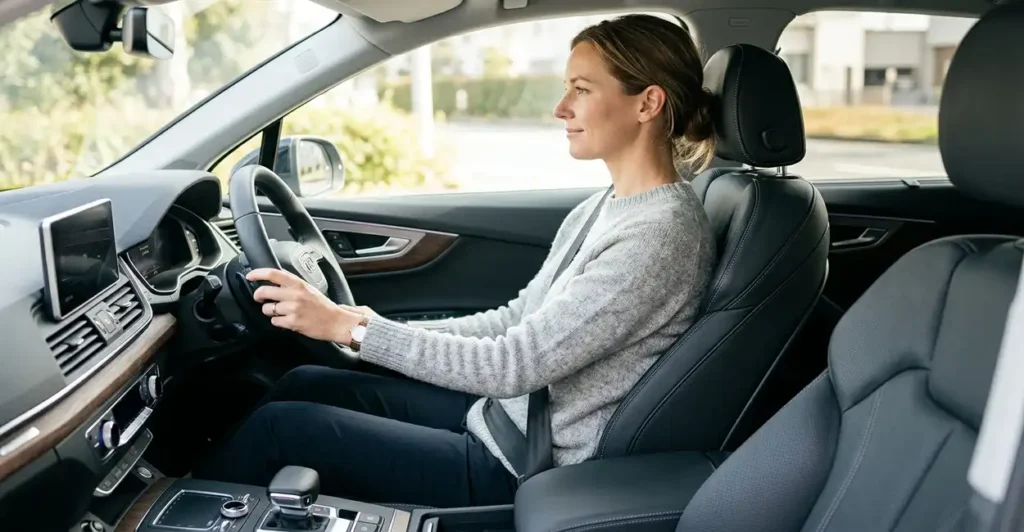
Driving with sciatica turns an ordinary commute into an endurance test. Patients describe the same pattern to me week after week: they feel reasonably well when they set off, then somewhere past the thirty-minute mark a deep ache starts in one buttock, travels down the back of the thigh, and by the time they park they need a minute before they trust the leg to hold them.
I treat spinal pain for a living, and I review vehicles through that lens. This guide explains what happens inside your body when you drive, why your car aggravates the sciatic nerve in ways that sitting at home does not, and exactly how I set up a seat when a patient tells me driving with sciatica has become the worst part of their day.
One thing to settle first. Sciatica describes a symptom, not a diagnosis. The word means pain radiating along the sciatic nerve pathway, and several very different problems produce it. That matters enormously here, because the seat position that rescues one patient makes another patient worse. I will show you how to work out which group you fall into rather than handing you a single set of angles and calling it medicine.
Why Does Driving With Sciatica Hurt More Than Sitting at Home?
Your armchair and your driver’s seat both involve sitting, yet patients consistently report that driving with sciatica hurts more. Five differences explain the gap.
You cannot shift position. At home you fidget constantly without noticing. Driving locks your pelvis, holds your right foot on a pedal, and keeps your hands forward on a wheel. Sustained loading in one position causes spinal tissues to creep — they slowly deform under constant load — and irritated nerve roots tolerate that poorly.
Your car vibrates. Every road surface transmits energy through the floor and seat into your pelvis. Researchers have studied this extensively in professional drivers, and the exposure counts as a genuine occupational risk factor rather than a nuisance.
Your seat probably forces a rounded lower back. Most seats place your hips low and tilt the base rearward, which rotates your pelvis backwards and flattens your lumbar curve. That posture increases pressure inside the lumbar discs.
Your right leg works constantly. Pedal control demands sustained low-grade activity in the muscles of one leg and hip, which produces genuinely asymmetric loading across your pelvis.
You often drive when tired. Posture drifts as concentration fades. Patients almost always report worse symptoms on the evening commute than the morning one.
A patient who taught me to look at the drive, not the spine
A man in his forties came to me convinced he needed surgery. His leg pain arrived every weekday and settled every weekend, and he assumed his disc was collapsing. His scan showed a modest disc bulge that explained some symptoms but not the timing.
I asked him to describe his seat. He drove ninety minutes daily in a vehicle with no lumbar adjustment, sitting low with the backrest reclined well past comfortable, phone in his back pocket. We changed nothing about his spine and everything about his position. His symptoms dropped substantially inside a fortnight. His disc had not healed in fourteen days — his loading pattern had changed.
That case reset how I approach anyone driving with sciatica. Before we discuss imaging, I want to know what happens in the seat.
What Research Tells Us About Driving With Sciatica
I built the recommendations below on published evidence. Four findings do most of the work.
Whole-body vibration acts as an independent risk factor
Occupational health researchers have documented higher rates of low back pain and sciatic symptoms among professional drivers than among the general working population, and whole-body vibration explains a meaningful share of that difference. Vibration in the 4–8 Hz band resonates with the human trunk, which fatigues the muscles that stabilise your vertebrae and increases loading on spinal tissues. The exposure matters enough that international bodies standardised its measurement under ISO 2631-1, and NIOSH publishes guidance for vibration-exposed workers. You can review the underlying literature through PubMed.
Practical consequence: tyre sidewall height and wheel size influence your symptoms more than buyers expect. A vehicle on 18-inch wheels with tall sidewalls transmits noticeably less energy into your pelvis than the same vehicle on 21-inch wheels.
Slumped sitting raises pressure inside your discs
Wilke and colleagues measured pressure inside a living human lumbar disc and published their findings in Spine in 1999. Their results corrected a widespread assumption. Relaxed, supported sitting did not generate dramatically higher disc pressure than standing. Slumping forward with an unsupported spine did — pressure rose sharply. Review the in-vivo disc pressure literature on PubMed.
Read that carefully, because it reframes the problem. Sitting is not the enemy. Collapsing is. A seat that holds your lumbar curve protects you even across a long drive.
Lumbar support reduces the work your muscles perform
Classical ergonomics research by Andersson and Ortengren, combining electromyography with disc pressure recording, showed that adding lumbar support and opening the backrest angle to roughly 100–110 degrees reduced both spinal muscle activity and disc pressure in seated subjects. Modern car seat design descends directly from that work.
Nerve tension testing explains why position matters so much
Clinicians assess suspected nerve root irritation with neurodynamic tests. The straight leg raise and the slump test both work by progressively increasing tension along the sciatic nerve — flexing the hip while extending the knee, and adding spinal flexion. When those manoeuvres reproduce a patient’s leg symptoms, they support a diagnosis of nerve root involvement.
Here is why that matters for driving with sciatica. A car seat holds your hip flexed and your spine somewhat rounded for an hour at a time. For a nerve root that already sits irritated, that combination applies a sustained low-grade version of the very position clinicians use diagnostically.
I want to be honest about the limits of that reasoning, though. It explains a mechanism; it does not predict every individual. Which brings us to the most important section in this article.
Why the Best Seat Position Depends on Your Sciatica Trigger
Most articles about sciatica and driving hand you fixed angles as though one geometry suits everyone. It does not, and any clinician who has run a spinal clinic knows it. The NICE guideline on low back pain and sciatica (NG59) treats sciatica as a presentation with multiple causes, and the NHS sciatica overview does the same.
Work out which broad pattern fits you, then adjust accordingly.
Pattern one: symptoms worsen with bending and sitting
These patients feel worse sitting, worse leaning forward, worse getting out of a low chair — and often better walking. Disc-related nerve root irritation commonly behaves this way, particularly in younger and middle-aged adults.
If this describes you, driving genuinely is one of your provoking positions. You need firm lumbar support, a more upright backrest, a higher hip position, and short intervals between breaks. Most of the setup advice below targets this group.
Pattern two: symptoms worsen with standing and walking, and sitting relieves them
These patients walk into clinic describing leg pain and heaviness that builds after a few hundred metres and eases the moment they sit down or lean on a trolley. Narrowing of the spinal canal or the nerve exit tunnels often produces this pattern, and it appears more frequently with increasing age.
If this describes you, driving may be one of the more comfortable things you do. Do not force yourself into a rigidly upright position because an article told you to. A slightly more open hip angle may suit you better, and your priority shifts towards managing the walk from the car park rather than the drive.
Pattern three: symptoms centre on the buttock and worsen with pressure
Some patients localise the problem to the deep buttock, feel it intensify on hard surfaces, and report tenderness on direct pressure. Irritation of the nerve within the deep gluteal region can behave this way.
If this describes you, the seat cushion and bolstering matter more than lumbar geometry. Aggressive sports-seat bolsters and firm, flat cushions tend to provoke symptoms. A pressure-relieving cushion often helps more than any backrest adjustment.
Nobody fits these boxes perfectly, and some people show features of more than one. Use them as a starting hypothesis, then let your symptoms tell you whether you guessed right. If you cannot work out your pattern, a physiotherapist or physician can usually identify it in a single consultation.
How to Sit in a Car With Sciatica: My Six-Step Setup
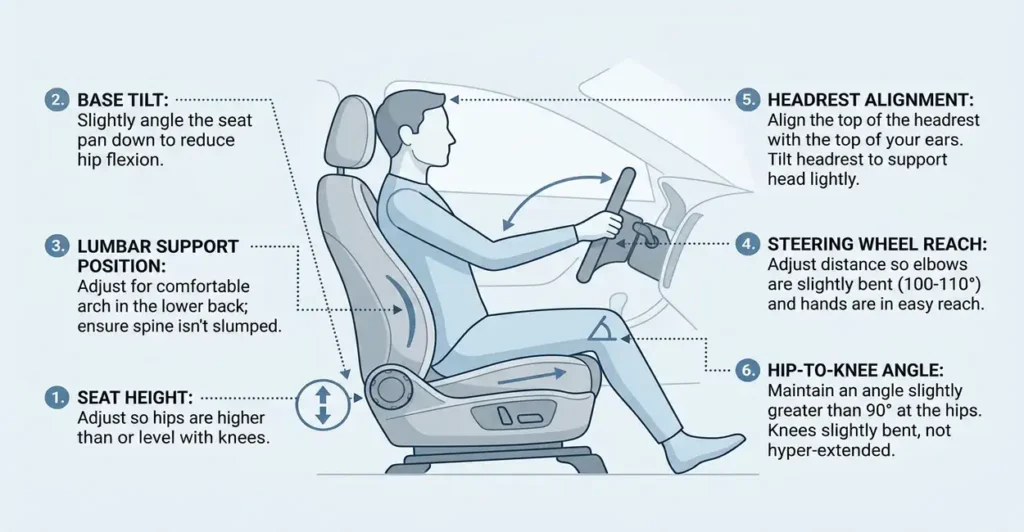
Follow this order. Almost everyone adjusts the steering wheel first, which locks in a poor spinal position before they start.
- Set seat height first. Raise the seat until your hips sit level with your knees or very slightly higher. Sitting with knees above hip level increases both spinal flexion and tension along the nerve pathway. Many drivers with sciatic symptoms need the seat higher than they instinctively choose.
- Adjust the seat base tilt. Aim for your thighs resting supported along the cushion, with no pressure behind your knees and no sense of sliding backwards. A heavily rearward-tilted base rotates your pelvis back and rounds your lumbar spine, which suits pattern-one patients poorly — though pattern-two patients sometimes tolerate it well.
- Set the backrest angle. Start around 100–110 degrees, consistent with the ergonomics evidence above. Reclining further feels relaxing and quietly transfers load onto your lower back while pushing your head forward.
- Adjust lumbar support. Fill the gap at your waistline, then back off slightly. Almost everyone over-inflates it. You want contact and gentle support, not a wedge pressing into your spine.
- Set steering wheel distance. Bring the wheel to you rather than reaching for it. Your shoulders should stay against the backrest with a relaxed bend at the elbow. Reaching forward pulls you off the lumbar support you just adjusted.
- Check pedal position last. Slide the seat so your knee keeps a soft bend when a pedal reaches the floor. A fully extended leg forces you to brace with your pelvis, and an over-bent leg raises your knee above hip level again.
Re-check the whole sequence after ten minutes of driving. Your body settles, and the setting that felt right in the driveway often needs one small correction.
Best Car Seat Position for Sciatica: My Starting Ranges
Treat these as a starting point rather than a prescription. Individual anatomy varies, and so does the cause of your symptoms.
| Element | Starting range | Reasoning |
|---|---|---|
| Backrest angle | 100–110° from the seat base | Reduces disc pressure and spinal muscle activity in seated ergonomics studies |
| Hip position | Level with or slightly above knee height | Limits spinal flexion and nerve tension |
| Knee angle at full pedal travel | Comfortably bent, not locked straight | Avoids bracing through the pelvis |
| Lumbar support | Firm contact filling the waist gap, no more | Maintains the lumbar curve without local pressure |
| Headrest | Base of skull level, close to the head | Keeps the neck neutral as posture drifts |
| Wheel | Reachable with shoulders on the backrest | Prevents forward pull off the lumbar support |
If a setting inside these ranges reproduces your leg symptoms, abandon the number and follow the symptom. Your nerve outranks my table.
Why Your Right Leg Often Hurts More When Driving With Sciatica
Patients raise this constantly, and drivers discuss it endlessly online: the right leg hurts more. Several factors plausibly contribute in right-hand-drive-pedal vehicles.
Your right leg holds a sustained, slightly abducted and externally rotated position on the accelerator, then repeatedly transfers to the brake. That produces continuous low-grade activity in the hip and gluteal muscles on one side. Your left leg, meanwhile, usually rests flat on the floor in an automatic vehicle. Asymmetric muscular activity across the pelvis for an hour will feel different on each side.
Add a second factor. Many drivers subtly rotate their pelvis to work the pedals, which shifts weight onto one buttock and loads one side of the lower back more than the other.
Two honest caveats. First, plenty of patients report left-sided symptoms while driving, and manual-transmission drivers work the clutch with the left leg constantly. Second, side dominance in sciatica usually reflects which nerve root sits irritated, not which pedal you press. Driving may unmask or amplify existing one-sided symptoms rather than cause them.
Still, if your right leg suffers specifically during drives, cruise control on longer routes helps a substantial number of my patients simply by letting the leg rest.
Is Your Car Seat Making Sciatica Worse?
Some seats work against you regardless of how carefully you adjust them. Watch for these features.
- Deep seat pans. A cushion that drops your hips well below your knees builds flexion into the position before you touch a control.
- Aggressive side bolsters. Sports trims squeeze the buttock and thigh from both sides, which pattern-three patients tolerate badly.
- Fixed lumbar foam. A moulded bulge that never adjusts fits almost nobody’s lumbar apex, because that apex sits at a different height in every spine.
- Short cushions. Unsupported thighs transfer load back into your pelvis and lower back.
- Very soft cushioning. Soft feels wonderful for ten minutes, then your pelvis sinks and rotates backwards.
- Large wheels with low-profile tyres. More vibration reaches your pelvis, for the reasons covered above.
If you are shopping for a vehicle, our ranking of the best SUVs for back pain and sciatica scores models specifically on these features, and the 50 best cars for back pain covers sedans and hatchbacks alongside SUVs. Individual assessments including the Honda CR-V, Toyota Highlander, Subaru Crosstrek and Toyota RAV4 break down seat geometry in detail, and you can browse the full review library.
The Wallet-in-the-Back-Pocket Problem
I raise this with every patient, and it surprises most of them.
A wallet, a phone, or a bunch of keys under one buttock tilts your pelvis, rotates your lower back, and applies direct pressure over the region the sciatic nerve passes through. You then hold that asymmetric position for the entire drive without noticing, because your body adapts to it within a minute.
The second patient story: a fortnight, a wallet, and no prescription
A woman in her fifties reported tingling and aching down the back of her right thigh, appearing only after roughly forty minutes at the wheel and never at any other time. Her examination showed mild findings. Her seat was decent.
She carried a thick wallet in her right back pocket and had done so for years. I asked her to move it to the door pocket and to raise her seat by two clicks. She returned two weeks later with almost no symptoms during driving.
I do not pretend a wallet caused her underlying problem. But it clearly tipped a borderline situation into a symptomatic one, and removing it cost nothing. Empty your back pockets before every drive. It remains the single cheapest intervention in this entire article.
Lumbar Support for Driving With Sciatica
Lumbar support helps, and more support does not automatically help more.
Built-in adjustable lumbar support beats every add-on when your vehicle offers it. Four-way power adjustment — depth plus height — matters far more than the number of massage programmes, because your lumbar apex sits at a specific height that differs from mine.
A lumbar roll suits drivers whose seats lack adjustment. Position it at waist level, not higher, and choose a modest thickness first. Patients routinely buy the largest roll available, jam their spine into extension, and create a new problem.
Wedge cushions raise the back of your seat base and tilt your pelvis forward, which restores the lumbar curve indirectly. These often help pattern-one patients considerably.
A pressure-relieving seat cushion addresses pattern three, where the problem sits in the buttock rather than the back.
One warning that applies to all of them: anything you add to the seat changes your position relative to the pedals, wheel, mirrors and airbag. Adding thickness beneath you raises your hip point and shortens your reach. Re-run the six-step setup after fitting any cushion, and never let a cushion compromise your control of the vehicle or your seatbelt geometry.
Our best car seat cushions for back pain buyer’s guide covers specific products I consider clinically sensible.
How Often Should You Stop When Driving With Sciatica?
I deliberately avoid quoting one universal interval, because published advice varies and so do patients. Recommendations in circulation range from roughly hourly stops to every thirty to sixty minutes, and I have patients who genuinely need to move every twenty minutes during a flare.
Use a symptom-guided rule instead: stop before symptoms arrive, not after. Identify the point at which your leg usually starts complaining, then schedule your break ten minutes earlier. If your leg reliably speaks up at forty minutes, stop at thirty.
When you stop, spend the time usefully. Stand up fully. Walk for two or three minutes. Perform a few gentle backward bends if extension eases your symptoms, or hold a gentle forward position if that is what helps you — follow your pattern, not a generic instruction.
Movement matters for a second reason too. Prolonged immobility in a vehicle raises venous thromboembolism risk, which I cover in detail in our road trip DVT prevention guide.
Planning a Road Trip While Driving With Sciatica
A long drive with sciatica needs planning rather than stoicism.
Before you leave. Walk for ten minutes rather than sitting until departure. Run the six-step setup properly while stationary. Empty your back pockets. Take your usual medication on your usual schedule instead of waiting for pain.
Pack deliberately. Bring your lumbar roll or cushion, a water bottle, and any medication you might need in the passenger compartment rather than the boot, so you never twist into a loaded reach to retrieve it.
Plan your stops in advance. Choose them by distance rather than by how you feel, because pain-driven decisions arrive too late.
Share the driving where possible. Two people alternating every hour beats one person enduring four.
Get in and out carefully. Sit down onto the seat sideways with both feet outside, then swing your legs in together. Reverse that on the way out. Climbing in one leg at a time forces you to rotate a loaded spine, and my sciatica patients tolerate that movement worse than almost anything else.
Know when to stop for the day. Escalating pain, a leg that feels progressively weaker, or symptoms that no longer settle during breaks all mean the drive should end.
When You Should Avoid Driving With Sciatica
This section matters more than the rest combined.
Stop driving and seek urgent medical assessment the same day if you develop any of the following: difficulty passing urine or loss of bladder or bowel control, numbness in the saddle area between your legs, weakness affecting both legs, or rapidly progressing weakness in one leg. These features raise concern about serious nerve compression that requires emergency evaluation, and both NICE NG59 and the NHS list them as red flags.
Do not drive if you cannot control the pedals reliably. Weakness affecting ankle or foot movement, or a leg that gives way, compromises emergency braking. Pain that distracts you severely does the same. Your legal duty to drive safely does not bend for sciatica, and insurers take an unsentimental view of the matter.
Check your medication. Some drugs prescribed for nerve pain cause drowsiness, dizziness or slowed reactions, particularly in the first days or after a dose increase. Ask your prescriber directly whether yours affects driving, and check your local rules on driving while taking them.
Get assessed if symptoms persist beyond a few weeks or keep returning, rather than continuing to manage them with cushions alone. Most sciatica improves with time and appropriate management, but persistent radiating leg pain deserves a proper clinical opinion.
Driving With Sciatica: Frequently Asked Questions
Can driving make sciatica worse? Yes, for many people. Sustained hip flexion, a rounded lower back, whole-body vibration and asymmetric pedal use combine in a way that few other daily activities replicate. That said, some patients with canal narrowing find driving more comfortable than walking, which is why identifying your pattern matters.
What is the best driving position for sciatica? Start with hips level with or slightly above your knees, a backrest around 100–110 degrees, firm lumbar support filling the waist gap, and a wheel close enough to keep your shoulders on the backrest. Then adjust based on what your symptoms actually do.
How should I sit in a car with sciatica? Adjust in this order: seat height, base tilt, backrest angle, lumbar support, wheel distance, then pedal reach. Setting the wheel first locks in a poor spinal position.
Why does my sciatic nerve hurt when driving? A car seat holds your hip flexed and your spine somewhat rounded, which places sustained tension along an already irritated nerve pathway, while vibration fatigues the muscles supporting your spine.
Can a car seat cause sciatica? A seat rarely causes the underlying problem, but a poorly designed or badly adjusted seat frequently converts a symptom-free spine into a symptomatic one and keeps a flare going.
Does lumbar support help sciatica while driving? Often, yes — particularly for people whose symptoms worsen with bending and sitting. Use modest support at waist level and increase it only if it genuinely helps.
How often should I stop on a long drive with sciatica? Stop before symptoms appear rather than after. Note when your leg usually starts complaining and schedule breaks ten minutes earlier than that.
Why does my right leg hurt more when I drive? Sustained accelerator use produces continuous asymmetric activity in one hip and gluteal region. Cruise control on longer routes helps many patients for exactly this reason.
Written by Dr. Nirosh (MBBS). Read more about our clinical review framework on the about page.
Medical disclaimer: This article provides general information about vehicle ergonomics and does not constitute medical advice, diagnosis or treatment. Sciatica has several possible causes, and management should follow individual assessment. Seek urgent medical attention for loss of bladder or bowel control, saddle numbness, or progressive leg weakness. Auto Health Review MD may earn a commission from qualifying purchases through affiliate links, which never influences our recommendations.