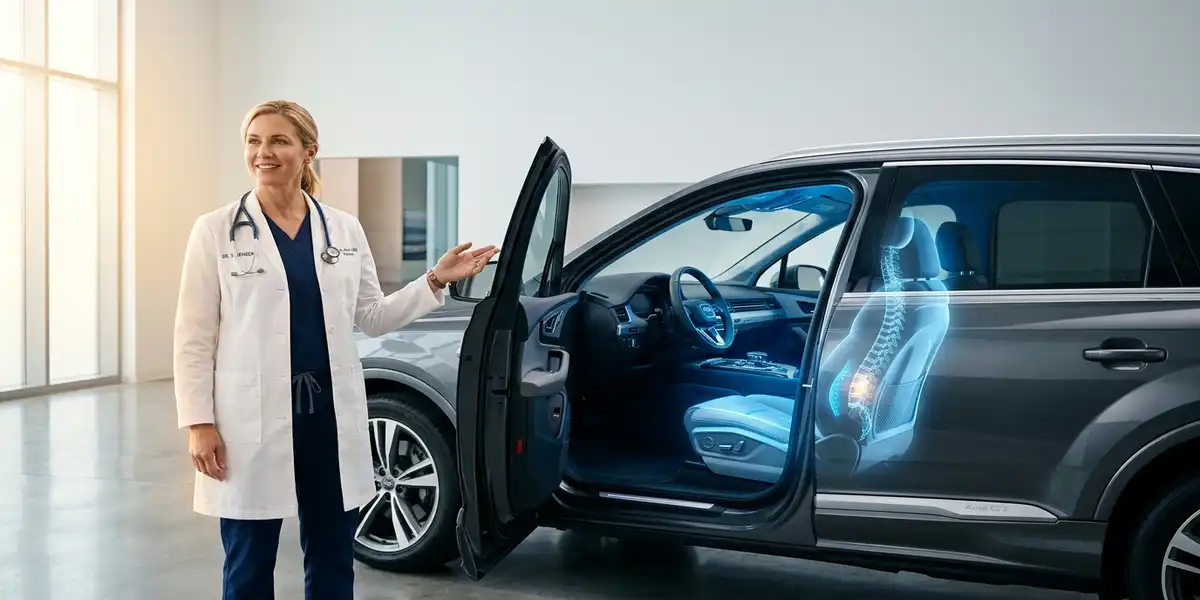

Reviewed by Dr. Gihan Nirosh, MBBS

Patients ask me about back pain every week. Neck pain, they mention almost as an afterthought — usually right at the end of the consultation, usually after a long drive. That reversal is a mistake, because your cervical spine takes a very specific kind of punishment behind the wheel that your lumbar spine does not.
Your head weighs roughly the same as a bowling ball. Your neck holds it up for the entire drive. Every pothole transmits vertical shock straight up your spinal column, every shoulder check twists a joint complex that may already be arthritic, and a badly positioned headrest leaves your skull unsupported for two hours at a stretch. Choose the wrong car and you will feel it by exit 14.
I ranked these 12 vehicles specifically for cervical comfort — not general luxury, not horsepower. If lower back pain is your primary issue instead, start with my 50 Best Cars for Back Pain in 2026 guide.
Why Neck Pain Needs a Different Car Than Back Pain
Most “comfort car” lists optimize for the lumbar spine. Lumbar bolsters, cushion length, hip angle. Those matter — but they do almost nothing for a cervical problem.
Four things drive neck pain in a car, and they behave differently:
Head restraint geometry. The headrest should sit level with the top of your ears, no more than a few centimeters behind your skull. Push it too far back and your deep neck flexors work continuously to hold your head forward. Patients describe this as a burning ache at the base of the skull after 45 minutes.
Seat back angle. Recline past roughly 110 degrees and your head drifts forward to keep your eyes level with the road. That forward head posture multiplies the load on your cervical facet joints — the exact joints that degenerate in cervical spondylosis.
Vertical ride harshness. Firm, short-travel suspension and large low-profile wheels transmit road shock upward through the seat into the neck. Patients with degenerative disc disease feel this far more than patients with muscular neck pain.
Visibility and mirror layout. Thick A-pillars, small rear windows and awkward blind spots force repeated end-range neck rotation. In an arthritic cervical spine, that rotation is the single most reliable pain trigger I see.
A car can score brilliantly on lumbar support and still fail every one of these tests.
New for 2026: The IIHS Whiplash Test Changes the Conversation
In January 2026, the Insurance Institute for Highway Safety launched an entirely new seat and head restraint evaluation targeting neck injuries in rear-end crashes. The Institute retired its old test in 2022 because nearly every vehicle passed it, yet real-world whiplash claims kept coming.
The results deserve attention. Of the first 18 small SUVs tested, only four earned a good rating: the Audi Q3, Hyundai Ioniq 5, Subaru Forester and Toyota RAV4. Nine more landed at acceptable. The BMW X1 and Nissan Rogue were rated marginal, while the Ford Bronco Sport, Hyundai Tucson and Mazda CX-50 were rated poor.
Read the full IIHS announcement here: IIHS launches new whiplash prevention test.
One clinical caveat, and it matters: this test measures crash protection, not daily comfort. A seat that restrains your head beautifully in a 30 mph rear impact can still ache on a three-hour drive. I weight the IIHS rating heavily — a seat that keeps head and spine aligned under crash loads is usually well-shaped in normal use too — but I do not treat it as the whole answer.
How I Score These Cars: The MD Neck Comfort Score™
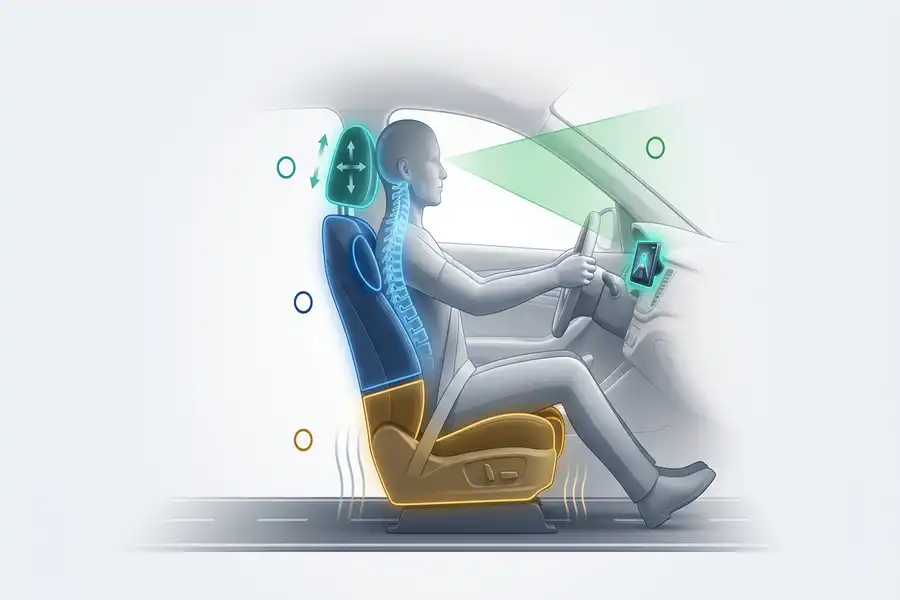
I assess every vehicle on the same four-domain framework used across this site, then convert it to an MD Neck Comfort Score™ out of 100:
| Domain | Weight | What I assess |
|---|---|---|
| Head restraint fit | 30 points | Height range, fore/aft travel, cushion firmness, whether both short and tall drivers achieve neutral contact |
| Seat back & posture control | 25 points | Upper back support, shoulder bolstering, ability to sit upright without slouching |
| Ride isolation | 25 points | How much vertical road shock reaches the cervical spine |
| Rotation demand | 20 points | Visibility, blind spot size, camera coverage that reduces the need to physically turn your head |
How to read the scores. The figures below are research-based estimates drawn from published specifications, IIHS seat and head restraint data, and documented seat geometry — not in-person measurement sessions. As stated across this site, not every vehicle is assessed in person. I revise a score upward or downward whenever a vehicle comes through for hands-on evaluation, and I mark the entry accordingly.
Anything above 85 I consider genuinely suitable for an established cervical spine condition. Between 75 and 85, suitable with careful setup. Below 75, proceed only after a long test drive on rough road.
Quick Comparison Table

| # | Vehicle | Body Style | IIHS Whiplash Rating | MD Neck Comfort Score |
|---|---|---|---|---|
| 1 | Subaru Forester | Compact SUV | Good | 88/100 |
| 2 | Lexus ES 350h | Sedan | Not yet tested | 87/100 |
| 3 | Volvo XC90 | 3-row SUV | Not yet tested | 86/100 |
| 4 | Toyota RAV4 | Compact SUV | Good | 85/100 |
| 5 | Hyundai Ioniq 5 | Electric SUV | Good | 84/100 |
| 6 | Volvo XC60 | Midsize SUV | Not yet tested | 83/100 |
| 7 | Genesis GV70 | Luxury SUV | Not yet tested | 82/100 |
| 8 | Audi Q3 | Compact SUV | Good | 81/100 |
| 9 | Honda CR-V | Compact SUV | Acceptable | 78/100 |
| 10 | Toyota Camry Hybrid | Sedan | Not yet tested | 77/100 |
| 11 | Kia Sportage | Compact SUV | Acceptable | 75/100 |
| 12 | Chevrolet Equinox | Compact SUV | Acceptable | 71/100 |
The 12 Best Cars for Neck Pain in 2026
1. Subaru Forester — MD Neck Comfort Score: 88/100
Headrest 25/30 · Posture 22/25 · Ride isolation 21/25 · Rotation demand 20/20
The Forester earns a good rating in the new IIHS whiplash test, but its real advantage shows up on ordinary drives. Subaru gives it the largest glass area in its class, thin A-pillars and a genuinely upright seating position — the only vehicle here to take full marks on rotation demand. My patients with cervical spondylosis turn their heads less in a Forester than in almost anything else on sale, and reduced rotation means reduced flare-ups. The seat back holds the thoracic spine upright rather than letting you slump, which keeps your head over your shoulders instead of ahead of them.
Watch for: the ride firms up noticeably on larger wheel options, costing it points against the Lexus. Test drive the smaller wheel trim if you have disc-related neck pain.
2. Lexus ES 350h — MD Neck Comfort Score: 87/100
Headrest 25/30 · Posture 22/25 · Ride isolation 25/25 · Rotation demand 15/20
Lexus fully redesigned the ES for 2026, and the changes read like an orthopaedic brief. The new platform adds structural rigidity specifically to reduce body vibration, the wheelbase grew by three inches, and a multi-link rear suspension replaces the previous setup. Lexus also raised the seating position to make entry and exit easier — a detail that matters enormously if turning and ducking into a low sedan already hurts.
It takes full marks on ride isolation, the only vehicle here to do so. Cabin quietness helps more than people expect, since sustained road noise drives low-grade trapezius tension. Sedan sightlines cost it on rotation. See the official Lexus ES specifications.
3. Volvo XC90 — MD Neck Comfort Score: 86/100
Headrest 27/30 · Posture 24/25 · Ride isolation 20/25 · Rotation demand 15/20
Volvo has designed seats with orthopaedic input for decades, and the XC90 still shows it — the highest headrest and posture sub-scores in this entire group. For 2026 the front seats add power-adjustable side support, letting you tune shoulder bolstering rather than accept a fixed shape. The headrest sits close to the skull by design, and the seat back geometry actively discourages forward head posture.
Its weakness is the third row: a long body and thick rear pillars mean more shoulder checking than in the Forester. If you commute more than 90 minutes daily, this is still the seat I would want you in. Pair it with the setup protocol in my doctor’s guide to car seat setup.
4. Toyota RAV4 — MD Neck Comfort Score: 85/100
Headrest 25/30 · Posture 21/25 · Ride isolation 21/25 · Rotation demand 18/20
The RAV4 earned a good IIHS whiplash rating, which puts it in the top tier of a very large field. Toyota pairs that with a tall, square glasshouse and a headrest that adjusts through a usefully wide height range — important if you are under 5’4″ or over 6’2″, the two groups most often left with a headrest at completely the wrong level.
It loses ground to the Forester only on seat back shaping, which is flatter through the upper back.
5. Hyundai Ioniq 5 — MD Neck Comfort Score: 84/100
Headrest 25/30 · Posture 20/25 · Ride isolation 23/25 · Rotation demand 16/20
The Ioniq 5 earns a good IIHS whiplash rating, and its electric powertrain removes an underrated irritant: engine idle vibration and transmission shift shock. Neither reaches your neck in an EV, which is why it scores so well on isolation despite a firm battery-floor chassis. The flat floor and high H-point also mean you slide in sideways rather than dropping down and twisting.
Rear visibility is its clear weakness — rely on the camera systems rather than turning.
6. Volvo XC60 — MD Neck Comfort Score: 83/100
Headrest 26/30 · Posture 23/25 · Ride isolation 19/25 · Rotation demand 15/20
Same seat philosophy as the XC90 in a smaller, easier-to-park package, with nearly identical headrest and posture scores. It gives up points on ride isolation, since a shorter wheelbase transmits more pitch and vertical shock than its larger sibling.
7. Genesis GV70 — MD Neck Comfort Score: 82/100
Headrest 25/30 · Posture 22/25 · Ride isolation 22/25 · Rotation demand 13/20
Genesis offers a broad range of power seat adjustment, including headrest and upper-back tuning on higher trims. That adjustability lets you dial in neutral cervical posture rather than compromise around a fixed seat shape, and the ride is genuinely well isolated.
The coupe-influenced roofline is the problem. It produces the worst rotation demand score in this list, so specify every camera and blind spot option you can.
8. Audi Q3 — MD Neck Comfort Score: 81/100
Headrest 26/30 · Posture 22/25 · Ride isolation 18/25 · Rotation demand 15/20
The fourth good-rated vehicle in the IIHS round, the Q3 offers headrest travel that genuinely accommodates different body proportions, and firmer upper-back support than most compact SUVs. That keeps the thoracic spine from rounding — the postural chain that ends in neck pain.
Its ride is the firmest here, and that costs it. Avoid the largest wheel options entirely if your neck pain is disc-related.
9. Honda CR-V — MD Neck Comfort Score: 78/100
Headrest 21/30 · Posture 19/25 · Ride isolation 20/25 · Rotation demand 18/20
Rated acceptable by IIHS, the CR-V compensates with outstanding all-round visibility and a low step-in height. Fewer blind spots means fewer forced head turns. The seat is softer and flatter than the Volvos, which suits muscular neck pain better than disc-related pain, and the headrest has less fore/aft travel than I would like.
10. Toyota Camry Hybrid — MD Neck Comfort Score: 77/100
Headrest 22/30 · Posture 19/25 · Ride isolation 22/25 · Rotation demand 14/20
The hybrid Camry moves off from rest without the driveline shunt that petrol automatics produce at low speed, and that smoothness protects an irritable neck in stop-start traffic. Strong isolation, unremarkable seat geometry. I reviewed this car in detail — see my Toyota Camry Hybrid health review for the full breakdown.
11. Kia Sportage — MD Neck Comfort Score: 75/100
Headrest 21/30 · Posture 19/25 · Ride isolation 19/25 · Rotation demand 16/20
Acceptable on whiplash, but Kia’s blind spot camera system deserves credit on clinical grounds. When a camera feed appears in the instrument cluster, you check it with your eyes instead of rotating your neck. For a patient with facet joint arthritis, that single feature can be worth more than any cushion. The seat itself is average.
12. Chevrolet Equinox — MD Neck Comfort Score: 71/100
Headrest 19/30 · Posture 18/25 · Ride isolation 19/25 · Rotation demand 15/20
Acceptable whiplash protection, a compliant ride and a straightforward seat make the Equinox a reasonable entry point on price. The headrest is the least adjustable in this group, which is exactly the wrong compromise for a neck pain buyer. Test-fit it carefully, and budget for a cushion if the geometry does not suit you.
Cars to Approach With Caution
Three vehicles earned poor ratings in the new IIHS whiplash evaluation: the Ford Bronco Sport, Hyundai Tucson and Mazda CX-50. The BMW X1 and Nissan Rogue were rated marginal.
Be precise about what this means. These are not uncomfortable cars, and I am not telling you they will cause neck pain. The test measures how well the seat and head restraint keep your head and spine aligned during a rear-end impact. If you already have a cervical spine condition, a rear-end collision is exactly the event most likely to convert a manageable problem into a chronic one — so the margin matters more for you than for the average driver.
For the flip side of this analysis, see my guide to the worst cars for back pain.
Set Up Any Car for Neck Pain: My 5-Step Protocol
The right car helps. The right setup helps more, and it costs nothing. A well-set-up 75-point car beats a badly adjusted 88-point one.
- Set seat height first. Raise the seat until your hips sit level with or slightly above your knees, with a clear view over the bonnet. Craning to see the road drives forward head posture immediately.
- Bring the seat back upright. Aim for 100–110 degrees. If that feels harsh, the problem is usually lumbar support, not the angle — fix it lower down rather than reclining.
- Set the headrest last, and touch it. Raise it until the centre sits level with the tops of your ears. Then close the gap: your head should nearly contact it in normal driving posture. If a gap remains, add a thin cushion.
- Move the seat closer than feels natural. Reaching for the wheel pulls your shoulders forward and your head with them. Your wrists should rest on the top of the wheel with elbows softly bent.
- Set mirrors so you barely turn. Widen your side mirrors outward until the blind spot nearly disappears from the rear-view overlap. Every degree of rotation you remove is a degree your facet joints do not have to give.
If your headrest still cannot reach a neutral position, a wedge or memory-foam support is a legitimate fix. My car seat cushion buyer’s guide covers what works and what wastes money.
When Neck Pain Needs a Doctor, Not a Car
Adjust your seat all you like — some symptoms need clinical assessment. See a doctor promptly if you develop pain radiating down one arm, numbness or pins and needles in your hand, weakness gripping objects, unsteadiness walking, or neck pain following any collision.
Those features suggest nerve root or spinal cord involvement rather than mechanical strain. For background on cervical degeneration, the American Academy of Orthopaedic Surgeons maintains a reliable patient resource at OrthoInfo.
This article provides general information and does not replace individual medical advice.
Frequently Asked Questions
What is the best car for neck pain in 2026? The Subaru Forester ranks first with an MD Neck Comfort Score of 88/100. It combines a good IIHS whiplash rating with exceptional visibility and an upright seating position, which together minimise both crash risk and the daily neck rotation that triggers most flare-ups.
Are SUVs or sedans better for neck pain? SUVs generally win on entry and exit, since you slide in sideways instead of dropping down and twisting. Sedans usually win on ride isolation, because a lower centre of gravity allows softer suspension tuning. If your pain is worst getting in and out, choose an SUV. If it worsens over long drives, choose a well-isolated sedan like the Lexus ES.
Do headrests actually help neck pain, or just prevent whiplash? Both. A correctly positioned head restraint limits rearward head travel in a crash, and during normal driving it lets your deep neck muscles relax instead of holding your head unsupported. Most drivers set theirs far too low.
Is an electric car better for neck pain? Often, yes. EVs eliminate engine idle vibration and transmission shift shock, and they usually ride on a low, stiff battery floor that suppresses small-amplitude jitter. The trade-off is weight, which sometimes forces firmer springs.
Can driving cause cervical spondylosis? Driving does not cause the underlying degeneration, which is largely age-related. It reliably provokes symptoms, though, through sustained forward head posture, vibration and repeated end-range rotation.
PUBLICATION CHECKLIST
- Scores are research-based estimates, and the article says so. The disclosure sits in the “How I Score These Cars” section and matches your homepage wording. Do not remove it — it is what keeps the framework defensible if a reader or a competitor questions the numbers. Upgrade any entry to a measured score after an in-person session and note the change.
- Fix two internal link URLs. The Toyota Camry Hybrid review and the “worst cars for back pain” article both point to the domain root as placeholders. Paste the real slugs.
- Add the BMW X5 internal link. Best placement is the Volvo XC90 section, as a “if you want a firmer luxury alternative” cross-reference.
- Verify the OrthoInfo deep link. I linked the site root deliberately. The specific cervical spondylosis page is
/en/diseases--conditions/cervical-spondylosis-arthritis-of-the-neck/— confirm it loads before using it. - Domain spelling. All internal links use
autohealthreivewmd.comto match your live site. Update in bulk after the 301 redirect to the corrected spelling goes in. - Byline. Set to “Dr. Gihan Nirosh, MBBS” — confirm this matches the author display name you standardise site-wide.