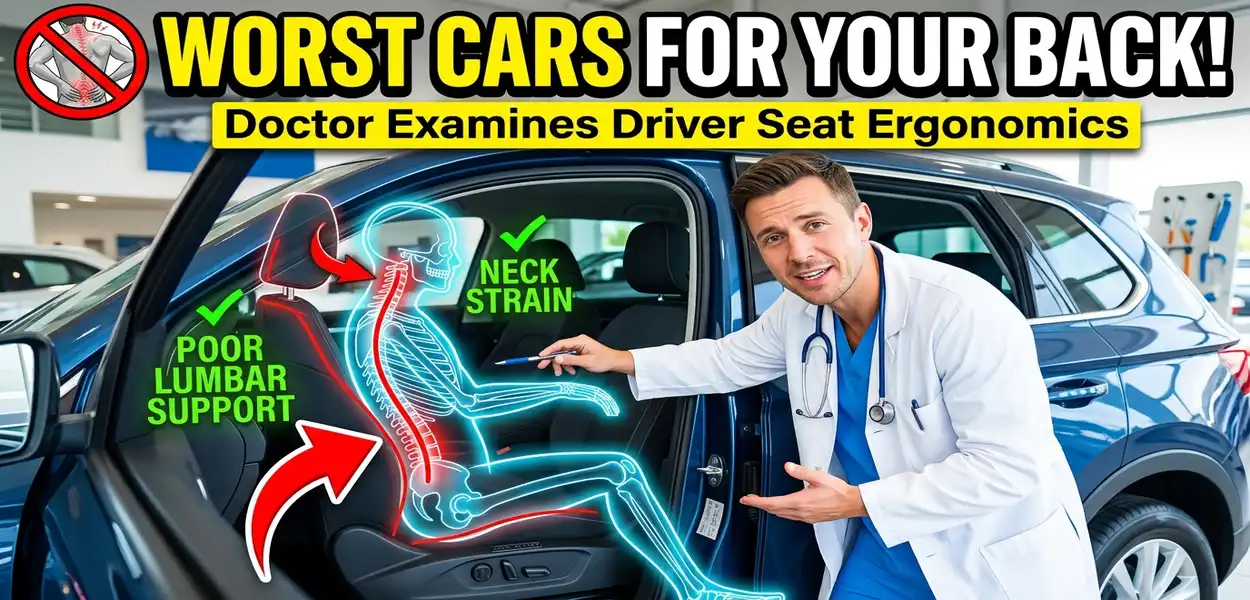

The worst cars for back pain rarely look like villains in a showroom. They look fast, sculpted and desirable, and buyers sign for them on the strength of a fifteen-minute test drive around a quiet suburb. Six weeks later they sit in my clinic asking why their back deteriorated.
I assess vehicles as a doctor rather than an enthusiast. Every week I meet patients whose spinal pain tracks their commute, and often the culprit sits in the driveway rather than inside the spine. This article names the cars and, more importantly, the design faults I ask patients to avoid — then points you towards better choices.
One important note before we start. Nothing here judges these cars on safety, build quality, reliability or driving pleasure. Several are genuinely brilliant machines that I would happily own myself. I am assessing one narrow thing: how their seats, ride and door apertures treat a spine that already hurts. Plenty of drivers live with these vehicles in perfect comfort. If you have back pain or sciatica, however, you belong to a group that needs to look harder.
Quick Answer: The Worst Cars for Back Pain at a Glance
| Category | Why it scores badly | Better direction |
|---|---|---|
| Low two-seat sports cars | Very low hip point, short cushions, minimal adjustment | Compact crossover with power lumbar |
| Sports and performance trims | Deep bucket seats, aggressive bolsters, large wheels | Comfort or mid trim of the same model |
| Coupe-roofline SUVs | Restricted door aperture forces ducking and twisting | Conventional-roofline equivalent |
| Small cars on run-flat tyres | Harsh vibration transmission, short wheelbase | Same class on conventional tyres |
| Budget A-segment city cars | Short cushions, thin padding, no lumbar adjustment | One class up with adjustable lumbar |
| High step-in off-roaders | Climbing entry loads a rotating spine | Crossover with a low sill |
How I Ranked the Worst Cars for Back Pain
I score every vehicle out of 100 using the MD Back Comfort Score, weighted across six domains: lumbar support system (25), seat base geometry (20), vibration isolation (20), entry and exit (15), driving position alignment (10) and long-drive endurance features (10). You can read the framework in full on our about page, and see it applied positively across the best SUVs for back pain and the 50 best cars for back pain.
Anything scoring below 70 lands in this article. I judge trim levels separately, because trim changes the answer completely — a point I will return to, since it may be the single most useful idea here.
What Makes a Car Bad for Back Pain? Six Design Faults
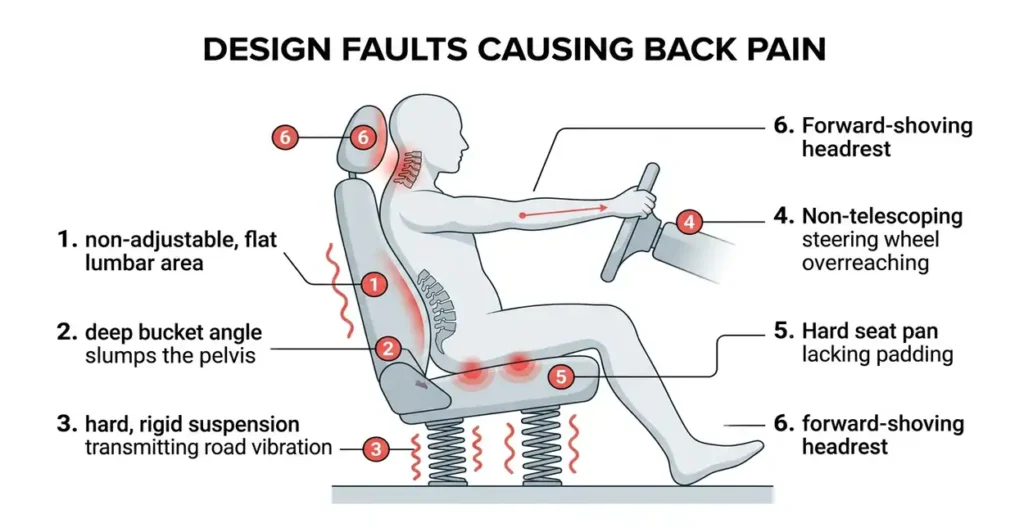
The worst car seats for back pain share recognisable features. Learn these six and you can assess any vehicle yourself in three minutes.
1. A hip point far below your knees. When you drop into a seat and your knees rise above your hips, your pelvis rotates backwards and your lumbar curve flattens before you touch a control. Getting out then demands a push from an already-loaded spine.
2. Fixed lumbar foam. A moulded bulge that never adjusts fits almost nobody, because the apex of the lumbar curve sits at a different height in every spine. Manufacturers advertise “sculpted lumbar support” on base trims and mean exactly this.
3. Aggressive side bolsters. Bolsters exist to hold you during cornering. They also squeeze the thigh and buttock from both sides, over the region where the sciatic nerve travels.
4. Short seat cushions. A cushion that ends well before your knee leaves your thigh unsupported and transfers load back into your pelvis and lower back.
5. Large wheels with low-profile tyres. Sidewall height absorbs road energy. Take it away and your pelvis absorbs that energy instead.
6. A narrow or low door aperture. Every entry becomes a duck, a twist and a drop rather than a sit and a swing.
Cars to Avoid With Back Pain: My 12 Picks for 2026
Low two-seat sports cars: the classic mistake
Mazda MX-5 · MD Score 52/100. Beautiful car, punishing ergonomics. The hip point sits close to the road, the cushion runs short, and the seat offers almost no adjustment beyond fore-aft and recline. Nobody with lumbar pain should commute in one. Who struggles most: anyone over 40, anyone with hip stiffness, anyone with sciatic symptoms. Buy instead: a compact crossover with four-way power lumbar.
Toyota GR86 and Subaru BRZ · MD Score 55/100. Firm suspension, low seating, minimal adjustment and a short cushion. Superb on a circuit, unforgiving on a daily commute. Buy instead: the Subaru Crosstrek, which shares the manufacturer’s character with a far kinder entry height.
Chevrolet Corvette · MD Score 50/100. A wide sill combined with a very low seat creates one of the most demanding entry movements on sale. The seat itself supports well; the process of reaching it does not. Buy instead: any grand tourer with a conventional door aperture, or accept it as a weekend car only.
Sports trims and bucket seats to avoid with back pain
This group frustrates me most, because buyers pay extra for the version that hurts them.
Performance trims with heavily bolstered seats — including BMW M Sport specifications, Audi S line sport seats and Alfa Romeo Quadrifoglio buckets — combine deep side bolstering with firmer damping and larger wheels. Fixed-back carbon shells fitted to the most focused models remove adjustment entirely. Who struggles most: patients with buttock-dominant sciatic symptoms. Buy instead: the comfort or mid trim of the same model, usually with better seats and a smaller wheel.
Hot hatchbacks in their sportiest specification follow the same pattern. Our review of the Hyundai Venue N Line shows how sports tuning changes the equation within a single model range.
Coupe-roofline SUVs: high seats undone by low doors
BMW X6, Mercedes-Benz GLE Coupé and Audi Q8 · MD Scores 60–66/100. These vehicles sell the promise of SUV comfort and then take away the one advantage an SUV offers a bad back: a generous door opening. The sloping roofline shrinks the aperture, so you duck your head, rotate your trunk and lower yourself simultaneously. Buy instead: the conventional-roofline sibling of the same car. An X5 treats your spine considerably better than an X6, and the Toyota Highlander does the job for far less money.
Small cars on run-flat tyres
Mini Cooper JCW and firm-riding compact BMWs · MD Scores 58–63/100. Short wheelbases already transmit road inputs sharply. Add run-flat tyres with reinforced sidewalls and large wheels, and vibration reaching your pelvis rises further. Buy instead: the same class on conventional tyres, or the softest suspension option in the range.
Budget city cars with no lumbar adjustment
A-segment hatchbacks such as the Suzuki Alto, Wagon R and their regional equivalents · MD Scores 48–58/100. These cars serve their buyers well on price and running costs, and I recommend them freely to people without spinal pain. For someone with established back trouble they present real problems: short cushions, thin padding, no lumbar adjustment, upright backrests with limited recline, and thin sound and vibration insulation. Buy instead: one class up, choosing any trim that offers adjustable lumbar support. The Honda Vezel represents a substantial ergonomic upgrade for used-import buyers in Asian markets.
High step-in off-roaders
Jeep Wrangler and Suzuki Jimny · MD Scores 55–62/100. Both demand a genuine climb, both ride firmly on short wheelbases, and both transmit considerable vibration. The Wrangler’s removable-door architecture also leaves you without a convenient grab point. Buy instead: a crossover with a low sill if you need the height but not the trail capability.
Electric cars with flat seat bases
Battery packs sit under the floor, which raises your hip point relative to the roof and often produces a knees-up seating position — the opposite of what most sciatic patients need. Base trims frequently pair that geometry with a flat cushion and limited lumbar adjustment. Our Tesla Model 3 health review covers the trade-off, and the BYD Sealion 7 and Volvo EX60 show how better-executed electric platforms handle it.
The Research Behind These Judgements
I did not assemble this list from opinion. Four bodies of evidence support it.
Whole-body vibration counts as a genuine risk factor. Occupational studies consistently show higher rates of low back pain among professional drivers than among the general working population, and vibration transmitted through the seat explains a meaningful part of that gap. Energy in the 4–8 Hz range resonates with the human trunk and fatigues the muscles that stabilise your vertebrae. International bodies standardised its measurement under ISO 2631-1, NIOSH publishes worker guidance, and you can review the literature on PubMed. This finding justifies penalising large wheels, low-profile tyres and run-flats.
Slumping raises disc pressure; sitting alone does not. Wilke and colleagues measured pressure inside a living human lumbar disc and reported the results in Spine in 1999. Relaxed, supported sitting produced pressure comparable to standing. Slumping forward without support raised it sharply. Review the in-vivo disc pressure literature. This is why fixed lumbar foam and collapsing seat cushions matter so much.
Lumbar support reduces measurable muscle work. Andersson and Ortengren, combining electromyography with disc pressure recording, showed that lumbar support and a backrest angle around 100–110 degrees lowered both spinal muscle activity and disc pressure. Every seat lacking adjustment fails that standard for most of its occupants.
Nerve tension explains position sensitivity. Clinicians test suspected nerve root irritation using the straight leg raise and slump tests, which work by increasing tension along the sciatic nerve through hip flexion and spinal flexion. A deep seat holds a mild version of that position for an hour. The NICE guideline NG59 and the NHS sciatica overview describe the underlying mechanisms.
For a positive counterpoint, Germany’s Aktion Gesunder Rücken — a body of physiotherapists and physicians — certifies car seats for spinal ergonomics. Very few manufacturers submit to that assessment. The ones who do tend not to appear on lists like this.
Two Patients Who Changed How I Judge the Worst Cars for Back Pain
The retirement present that lasted four months
A man in his sixties bought himself a low sports coupé to mark his retirement. He had waited thirty years for it. He came to see me four months later, not because the seat hurt while driving, but because getting out of the car had become the worst moment of his day. He was pushing himself upward from a deep seat with a rotating, loaded spine, ten to twelve times daily.
We changed nothing medically. He sold the car, bought a crossover, and kept the coupé’s registration plate as a souvenir. His pain settled within weeks. That case is why entry and exit carries fifteen points in my scoring rather than five.
Same car, different trim, different outcome
A woman in her thirties described worsening buttock and thigh pain after changing cars. She had moved between two examples of the same model — from a comfort specification to a sports specification with heavily bolstered seats and larger wheels.
Her spine had not changed. Her seat bolstering, cushion firmness and vibration exposure all had. She switched back to a comfort-trim example and her symptoms improved substantially.
I now ask every patient which trim they drive, not just which car. Buyers research models exhaustively and ignore trim, yet trim frequently decides the outcome.
Worst Cars for Sciatica vs Ordinary Back Pain
The two conditions do not want the same seat, and treating them identically is where most car advice goes wrong.
Ordinary mechanical low back pain responds mainly to maintaining the lumbar curve and limiting vibration. A firm seat with good lumbar support usually helps, and a slightly rearward-tilted seat base is often tolerated well.
Sciatica describes pain radiating along the sciatic nerve, usually from irritation of a nerve root. It responds to tension and pressure along that pathway rather than to cushioning alone. So the worst cars for sciatica share a partly different profile:
- Deep seat pans that hold the hip flexed matter more here than they do for simple backache.
- Aggressive bolsters that compress the buttock matter far more.
- A firm, flat cushion can provoke symptoms even in a car with excellent lumbar support.
And a genuine complication: sciatica behaves differently between patients. Some feel worse sitting and better walking, which makes driving one of their provoking activities. Others — often with narrowing of the spinal canal — feel better sitting and worse walking, and may drive comfortably in a car this article criticises. I explain how to identify your own pattern in our full guide to driving with sciatica.
Do not let a list override your own experience. Use it to shortlist, then test.
Are Low Cars Bad for Back Pain?
Usually, yes, and the reason has less to do with the seat than with the doorway. Low car seats create back pain problems in two places: the position they hold you in, and the movement required to leave them.
Sitting low with knees above hips flattens the lumbar curve. Rising from that position requires you to push upward and rotate simultaneously, loading the spine in flexion and torsion together — a combination spinal researchers regard as demanding. Repeat it a dozen times a day and a borderline back becomes a painful one.
Height alone does not settle the question, though. A well-designed low car with an adjustable seat and a wide door aperture can beat a poorly designed tall one. Measure the movement, not the marketing.
Are Bucket Seats Bad for Sciatica?
Bucket seats create two distinct problems for sciatic symptoms. First, the deep pan holds the hip flexed and the pelvis rotated backwards. Second, the bolsters apply lateral pressure directly over the buttock and outer thigh.
Patients whose symptoms centre on the deep buttock notice this immediately. Patients whose symptoms arise higher in the lumbar spine sometimes tolerate bucket seats surprisingly well, provided the lumbar support works.
Fixed-back competition shells remove adjustment altogether. If you have any radiating leg symptoms, avoid them.
Can a Car Seat Cause Sciatica?
Here I want to be precise, because loose language on this point misleads people.
A car seat rarely causes the underlying pathology. Nerve root irritation typically arises from disc changes, narrowing of the nerve exit tunnels, or irritation within the deep gluteal region. A seat does not create a disc herniation.
What a seat does do — reliably, and in my clinic constantly — is convert a spine that was managing quietly into a spine that hurts, and then keep the flare going. That distinction matters for two reasons. It means changing your car will not cure a compressed nerve root, and it means changing your car may still dramatically reduce your symptoms. Both statements are true at once.
Sustained loading, vibration exposure and asymmetric position all plausibly contribute. If your car seat makes sciatica worse, take that seriously and act on it, but also get the underlying problem assessed properly rather than treating cushions as a diagnosis.
Does Firm Suspension Make Back Pain Worse?
Often, yes — and buyers underestimate how much of this they choose themselves.
Firmer damping and larger wheels transmit more road energy into the cabin. Given the vibration evidence above, that matters for anyone spending real hours behind the wheel. Two practical points follow.
First, wheel size sits within your control at purchase. The same vehicle on 18-inch wheels with tall sidewalls rides measurably calmer than on 21-inch wheels with 40-series rubber. Buyers routinely upgrade wheels for appearance and then wonder why their back deteriorated.
Second, adaptive dampers help if you actually use the comfort setting. Many owners leave the car in sport permanently. Do not.
Do Run-Flat Tyres Affect Ride Comfort?
Yes. Run-flat tyres carry reinforced sidewalls so the tyre supports the vehicle after a puncture, and that stiffer construction transmits more road texture into the cabin than an equivalent conventional tyre.
Several manufacturers fit them as standard, particularly on models without a spare wheel. If you have back pain and your car wears run-flats, switching to conventional tyres at replacement time — where the vehicle permits it, and with a tyre repair kit or spare aboard — ranks among the cheapest meaningful improvements available. Discuss it with a competent tyre specialist first, since some vehicles depend on run-flats for their handling calibration.
What Should You Buy Instead?
Avoiding the worst cars for back pain only solves half the problem. Our ranking of the 15 best SUVs for back pain and sciatica covers the models I actively recommend, scored on the same six domains, and the 50 best cars for back pain extends that across sedans, hatchbacks and MPVs.
Individual assessments worth reading before you commit include the Honda CR-V, Toyota RAV4 and Kia Sportage, or browse the whole review library.
If you cannot change cars right now, a well-chosen cushion closes part of the gap. Our best car seat cushions for back pain buyer’s guide covers lumbar rolls and wedges I consider clinically sensible, and planning long journeys properly helps too — see our road trip DVT prevention guide.
How to Test a Car Before Buying If You Have Back Pain
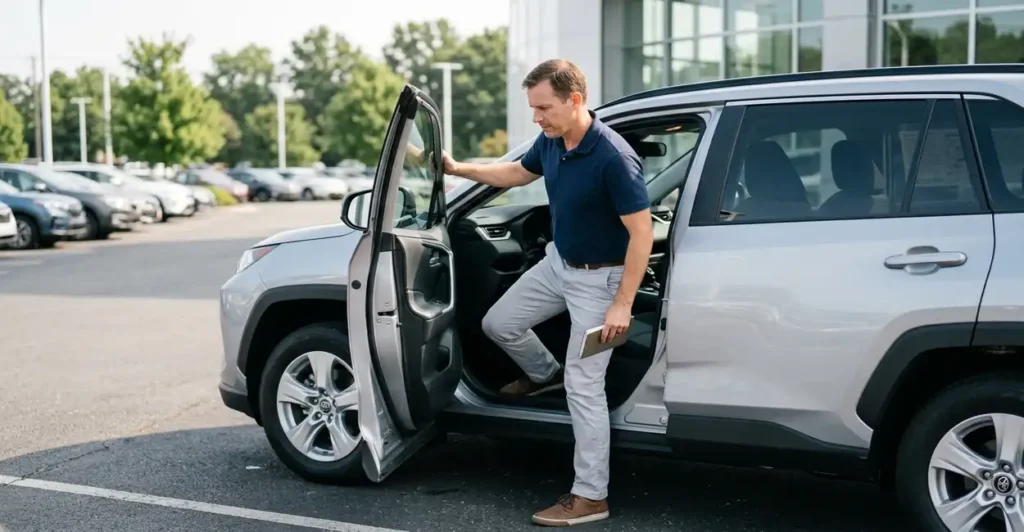
Showroom test drives are designed to sell cars, not to reveal ergonomic faults. Run this protocol instead.
- Enter and exit ten times before you drive anywhere. Count how many demand a duck, a twist or a push. This test alone eliminates most of the worst cars for back pain.
- Check the trim, not just the model. Ask which seats and wheel size the demonstrator carries. Insist on driving the specification you intend to buy.
- Adjust the seat properly while stationary. Seat height first, then base tilt, backrest angle, lumbar support, wheel distance, pedal reach. Never the wheel first.
- Verify lumbar adjustment axes. Two-way moves in and out. Four-way moves up and down as well. Ask, because brochures blur the distinction.
- Drive for forty-five minutes minimum, on roads you actually use. Symptoms usually surface after thirty minutes, long after a standard showroom loop ends.
- Include rough surfaces deliberately. Smooth tarmac tells you nothing about vibration.
- Sit in it once more at the end. Note how you feel getting out for the final time, when you are tired. That moment predicts your ownership experience better than the first minute.
- Take a second drive on a different day before signing, ideally in the evening when your back already feels tired.
Worst Cars for Back Pain FAQ
What are the worst cars for back pain in 2026? Low two-seat sports cars, sports and performance trims with deep bucket seats, coupe-roofline SUVs, small cars on run-flat tyres, budget A-segment hatchbacks without lumbar adjustment, and high step-in off-roaders. The design fault matters more than the badge.
Are SUVs always better than cars for back pain? Usually, because of hip point height — you sit down and slide across rather than lowering and folding. Coupe-roofline SUVs give that advantage back by restricting the door aperture.
Can changing my car fix my back pain? It can reduce symptoms substantially, sometimes dramatically. It will not fix underlying pathology. Pursue both.
Which is the easiest car to get in and out of with back pain? Look for a hip point close to your standing hip height, a wide and square door opening, a flat sill and a solid grab point. Mid-size crossovers usually win.
Do bucket seats cause sciatica? They do not cause the underlying problem, but deep pans and firm bolsters frequently aggravate symptoms, particularly when pain centres on the buttock.
Should I avoid large wheels if I have back pain? Choose the smallest wheel your preferred trim offers. Taller tyre sidewalls absorb energy your spine would otherwise absorb.
Is a firm seat bad for back pain? No. Firm and supportive helps; soft and collapsing does not. Softness feels better for ten minutes and worse for two hours.
Written by Dr. Nirosh (MBBS).
Editorial note: MD Back Comfort Scores reflect our assessment of ergonomic suitability for drivers with existing spinal pain. They express our professional opinion and make no judgement about any vehicle’s safety, quality or reliability. Individual comfort varies with body proportions, trim level and the specific cause of a person’s symptoms.
Medical disclaimer: This article provides general information about vehicle ergonomics and does not constitute medical advice, diagnosis or treatment. Seek urgent medical attention for loss of bladder or bowel control, numbness between the legs, or progressive leg weakness. Auto Health Review MD may earn a commission from qualifying purchases through affiliate links, which never influences our scoring.