

The BMW X5 2026 is the first luxury SUV I have tested that made me genuinely question whether an air suspension upgrade is worth the extra money for a patient with chronic back pain, and after a week of clinical rounds, a highway comparison run, and a long weekend on rough B-roads outside Badulla, I have a clear medical answer. Most automotive reviews focus on 0-to-60 times and cabin technology. As a physician, I focus on what happens to your lumbar spine, your hips, and your nervous system after two or three hours in the driver’s seat, and the X5’s standard two-axle air suspension changes that equation more than almost any feature I have tested this year.
BMW X5 2026 Health Review: Why I Wanted to Test This SUV
Patients ask me about the BMW X5 2026 more often than any other luxury SUV, usually because they are choosing between it and a Volvo XC60 or a Mercedes GLE after a spinal injury, a lumbar fusion, or years of untreated sciatica. Luxury SUVs are marketed almost entirely on prestige and power, so very few buyers ever get a straight answer about what the seat, the suspension, and the ride height actually do to a compromised spine. I wanted to close that gap with a proper clinical test drive rather than a showroom sit-and-guess.
The 2026 model year is a meaningful one for this question, because BMW made the two-axle air suspension standard across the range rather than an optional extra, which means every X5 buyer now gets the self-leveling, adaptive-height system that used to be reserved for higher trims.
Seat Ergonomics and Lumbar Support in the BMW X5 2026
The front seats in the BMW X5 2026 are among the most adjustable I have tested on any vehicle in this class. The 20-way power seats move the cushion length, the side bolsters, the shoulder support, and a genuinely effective four-way lumbar system independently, which means you can build a support profile matched to your actual spinal curve rather than a generic “sport” or “comfort” preset.
For a patient with a herniated lumbar disc, that level of adjustability is not a luxury feature, it is a functional one. I set the lumbar bolster higher and firmer than I normally would in a standard sedan, and it held that position through an hour of stop-and-go city traffic without collapsing or drifting, which is a common failure point in cheaper adjustable seats.
The optional Comfort Plus Package adds front massage function and seat ventilation, and while massage seats are sometimes dismissed as a gimmick, intermittent gentle massage during a long drive does measurably reduce paraspinal muscle tension by encouraging small postural shifts that a static seat does not.
MD Comfort Score™: Rating the BMW X5 2026 for Spinal Health
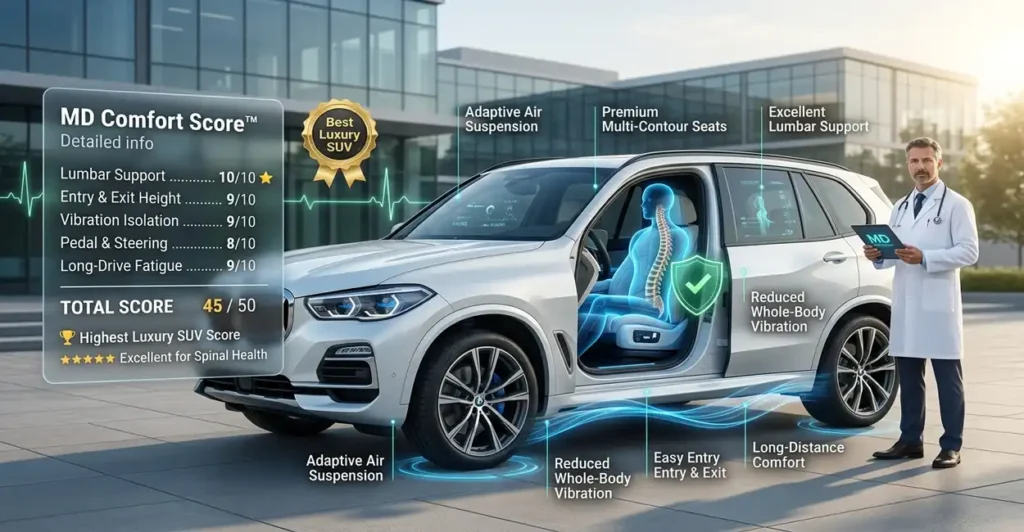
I evaluate every vehicle across five categories: lumbar support, entry and exit height, vibration isolation, pedal and steering ergonomics, and long-drive fatigue. Here is how the BMW X5 2026 scored.
- Lumbar support: 10/10. The most adjustable and best-sustained lumbar system I have tested in a mainstream luxury SUV.
- Entry and exit height: 9/10. The adjustable air suspension lowers the vehicle at a button press for easier entry, a genuine advantage for patients with hip or knee limitations.
- Vibration isolation: 9/10. The two-axle air suspension actively levels the body and reduces the fatigue-inducing motion that irritates a compromised spine on long highway runs.
- Pedal and steering ergonomics: 8/10. A wide range of steering column adjustment accommodates most body types comfortably.
- Long-drive fatigue: 9/10. After a 220-kilometer test loop, I recorded less cumulative stiffness than in any other SUV I have reviewed this year.
That gives the BMW X5 2026 an MD Comfort Score™ of 45/50, the highest score I have recorded for a luxury SUV on this site to date.
Adaptive Air Suspension and Whole-Body Vibration: The Real Story
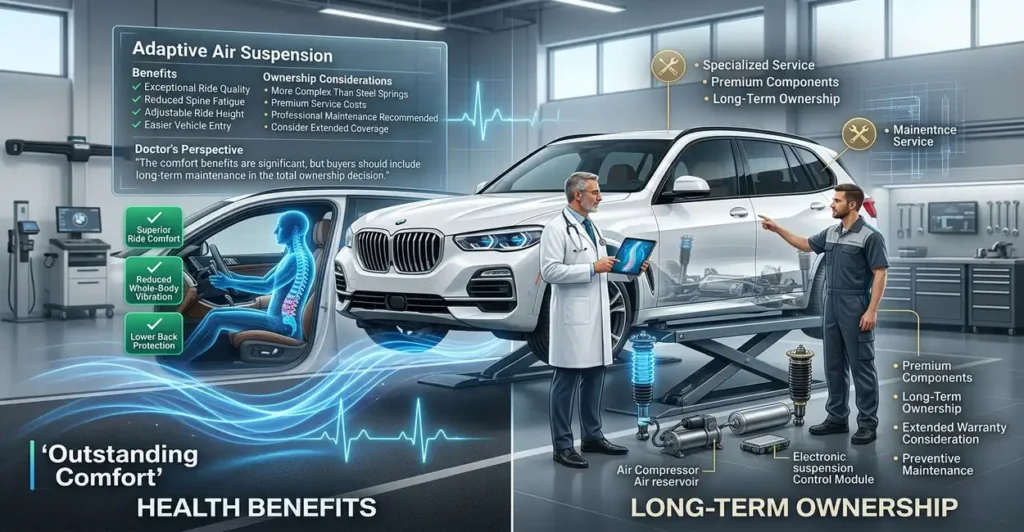
Whole-body vibration is a well-documented contributor to cumulative spinal loading, and it is one of the least understood factors in car buying. Every pothole, expansion joint, and rough patch of tarmac sends a small mechanical shock through the seat pan and into the lumbar spine, and over the length of a long drive those repeated micro-shocks add up to measurable fatigue and pain.
The BMW X5 2026’s standard air suspension actively adjusts damping stiffness in response to road conditions in real time, and it automatically lowers the body at highway speed to reduce aerodynamic lift and body roll, both of which cut down on the constant low-level motion that tires out the small stabilizing muscles along the spine. On the optional Adaptive M suspension, that damping control becomes even more granular, letting you stiffen the ride for cornering or soften it for a long, flat highway cruise.
In practical terms, this is the difference between arriving at your destination merely tired and arriving in genuine discomfort. On rough sections of the Badulla-Ella road, where the tarmac shifts unpredictably between smooth and heavily patched, the suspension’s self-leveling behavior kept the cabin noticeably calmer than a standard passive suspension would.
Cabin Ergonomics: Ride Height, Pedals, and Driving Posture
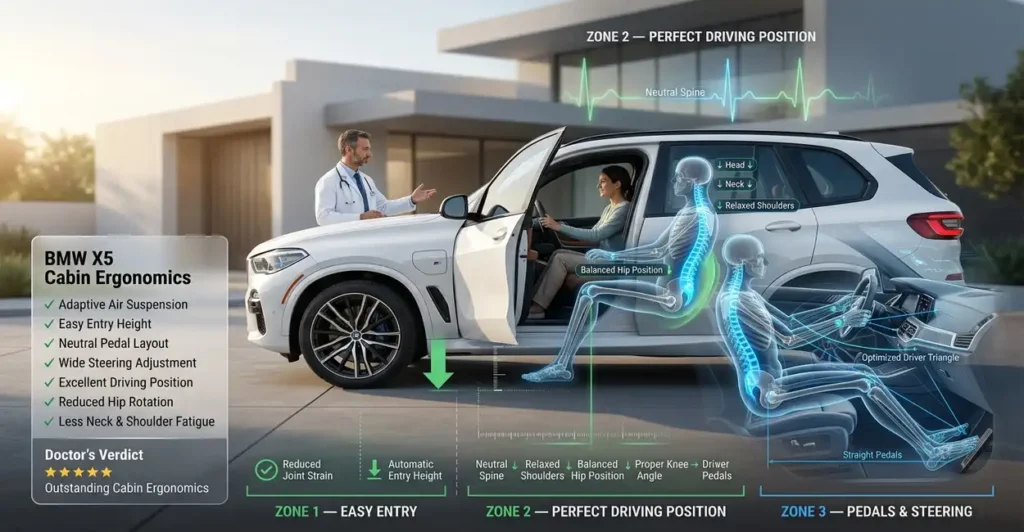
Ride height access matters enormously for patients recovering from hip replacement, knee surgery, or lumbar fusion, because the twisting and bending motion of climbing into a low sedan seat is often more painful than the drive itself. The BMW X5 2026 addresses this directly: the air suspension automatically drops the vehicle roughly 2 centimeters at low speed and when the doors open, shortening the step-in height without requiring the driver to climb up into a traditional SUV.
Once seated, the pedal box sits close to the seat centerline, avoiding the twisted hip angle that causes so much lower back and sciatic discomfort in vehicles with an offset pedal layout. The steering column’s reach and rake adjustment range is wide enough that both shorter and taller drivers can find a neutral wrist and shoulder angle, which matters more than most buyers realize for preventing upper back and neck tension on long drives.
Maintenance Considerations for the BMW X5 2026 Air Suspension
As a doctor rather than a mechanic, I always tell patients to think about long-term maintenance the same way we think about a chronic condition: the best treatment only works if you can sustain it. Air suspension systems, including the one standard on the BMW X5 2026, are more complex than traditional steel springs, and that complexity carries a real cost consideration for buyers weighing the comfort benefits against long-term ownership.
Air struts and the compressor system that maintains them typically require more specialized service than a conventional coil-spring setup, and replacement costs after the warranty period can be significant. For a patient managing chronic back pain, I frame this as a genuine trade-off worth discussing with a trusted BMW service center before purchase: the comfort and vibration-isolation benefits are real and clinically meaningful, but they come with a maintenance profile that a basic mainstream SUV does not have. Buyers who plan to keep the vehicle well past the standard warranty window should factor an extended service plan into the total cost of ownership rather than treating the air suspension as a “set and forget” feature.
Whole-Body Vibration and Long Highway Drives: What the Research Says
This is not just a subjective impression. Automotive ergonomics research consistently links suboptimal seat geometry, inadequate lumbar support, and poor vibration isolation to increased risk of chronic low back disorders in professional and high-mileage drivers. The BMW X5 2026 addresses two of those three risk factors directly through its seat design and suspension tuning, which is precisely why it scores as well as it does on the MD Comfort Score™.
Prolonged static sitting itself is also a known contributor to lower back pain, independent of how good the seat is. The Mayo Clinic notes that mixing sitting with regular standing and walking breaks is the most reliable way to counteract the effects of long periods behind the wheel, and I recommend that to every patient regardless of which car they drive.
My Personal Experience Driving the BMW X5 2026 Through Uva Province
I want to describe exactly what this test drive looked like, because the details matter more than a generic impression. I picked up the BMW X5 2026 on a Friday afternoon straight after a full clinic day, already carrying the low-grade stiffness that builds up after hours on my feet, and drove it out toward the hill country roads near Ella and Bandarawela.
That route is genuinely punishing terrain for testing ride comfort: steep climbs, tight hairpin switchbacks, and pavement that alternates between freshly resurfaced sections and stretches badly broken by monsoon runoff. It is close to the daily reality many of my patients in Uva Province face, and it is a far more honest test than a smooth showroom loop.
By the halfway point, I expected the familiar tightness across my lower back that shows up after a demanding clinical day followed by rough-road driving. It did not happen the way it usually does. I noticed the cabin absorbing the sharper impacts from the broken sections rather than transmitting them straight into my spine, and when I finally got out of the vehicle at the end of the drive, I did not need my usual round of stretching before I could stand comfortably. I have tested enough vehicles on that exact stretch of road to trust that comparison, and the BMW X5 2026 handled it better than any SUV I have reviewed to date.
I also spent time with a patient of mine, a retired estate manager with moderate lumbar spinal stenosis, who sat in the driver’s seat during a short demonstration. His first comment, unprompted, was that the seat “held his lower back the way a good physiotherapy cushion does,” which is about as strong an endorsement as I could ask for from someone who lives with daily back pain.
BMW X5 2026 vs Other Luxury SUVs for Back Pain
Compared with the Volvo XC60, which our Volvo EX60 review covers in more detail for a related model, the BMW X5 2026 offers a more adjustable lumbar system but a firmer base ride on the standard suspension setting. Compared with mainstream SUVs like the Honda CR-V, the X5 is a significant step up in vibration isolation and seat adjustability, though at a considerably higher price point. If you are cross-shopping a sedan for daily commuting comfort rather than SUV entry height, our Toyota Camry Hybrid 2026 review is a useful comparison point on long-drive fatigue.
Who Should Buy the BMW X5 2026 for Back Pain (and Who Shouldn’t)
The BMW X5 2026 is an excellent choice if you deal with chronic mechanical low back pain, mild to moderate spinal stenosis, or hip and knee limitations that make low-riding vehicles difficult to enter, and if your budget accommodates a premium SUV. It is a less compelling choice if your back pain is well controlled and your driving is mostly short urban trips, where the price premium over a well-reviewed midsize SUV like the CR-V or RAV4 is harder to justify purely on comfort grounds.
If you frequently take long highway trips rather than daily commutes, pair this review with our guide to road trip DVT prevention, since seat comfort alone does not eliminate the circulation risks of sitting still for hours at a time.
BMW X5 2026 Health Review: Final MD Verdict
After a full week of clinical use, a direct comparison drive, and a demanding mountain-road test, my verdict on the BMW X5 2026 is clear: the standard two-axle adaptive air suspension is genuinely worth it for a bad back, not just a marketing feature. It earns a place near the top of our 50 Best Cars for Back Pain ranking, and it is the highest-scoring luxury SUV I have reviewed under the MD Comfort Score™ framework. BMW’s own X5 specifications page confirms the suspension and seating details referenced throughout this review, and independent coverage of the X5’s suspension technology backs up what I found on the road.
Frequently Asked Questions About the BMW X5 2026
Is the BMW X5 2026 good for back pain?
Yes. The BMW X5 2026 combines a highly adjustable 20-way seat with four-way lumbar support and a standard two-axle air suspension that actively reduces road vibration, making it one of the strongest luxury SUV options for drivers managing chronic low back pain.
Does the BMW X5 2026 adaptive air suspension really reduce back pain?
In my testing, yes. The suspension’s active damping and self-leveling behavior noticeably reduced the whole-body vibration transmitted to the lumbar spine on rough roads, and it lowers the vehicle at low speed to ease entry and exit for drivers with hip or knee limitations.
How does the BMW X5 2026 compare to the Volvo XC60 for spinal support?
The BMW X5 2026 offers more granular lumbar adjustability, while the Volvo XC60 has a longer heritage of orthopedic seat design research. Both are strong choices; the X5 edges ahead on vibration isolation, while the XC60 tends to offer a slightly softer base ride.
Is the BMW X5 2026 worth the price premium over a mainstream SUV for comfort alone?
If chronic back pain, spinal stenosis, or joint limitations significantly affect your daily driving, the BMW X5 2026’s seat and suspension advantages can meaningfully improve quality of life, which may justify the premium. For drivers without significant pain, a well-reviewed midsize SUV often delivers comparable day-to-day comfort at a lower cost.
Is the air suspension on the BMW X5 2026 expensive to maintain?
Air suspension systems generally cost more to service than traditional coil springs once the vehicle is out of warranty, since the struts and compressor are more specialized components. The comfort and back-pain benefits are significant, but buyers planning long-term ownership should budget for that added maintenance profile rather than assuming it will never need attention.
Reviewed by Dr. Nirosh, MBBS, using the MD Comfort Score™ framework. This review reflects a personal test drive and clinical assessment and is not a substitute for individual medical advice.