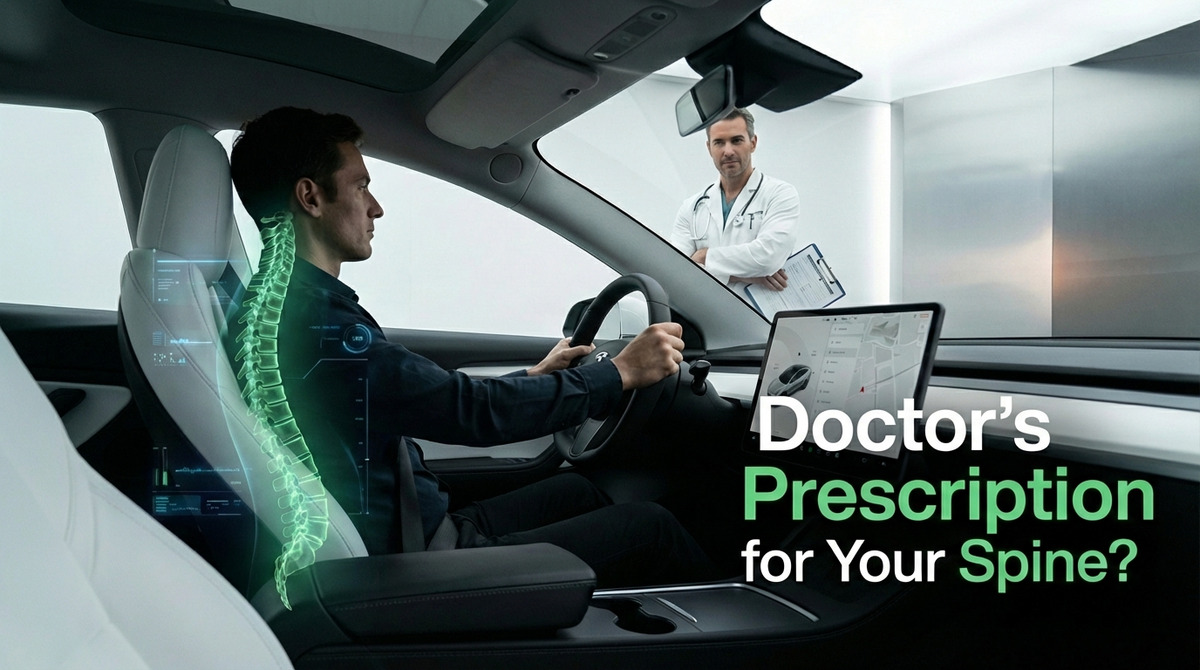


The Toyota Camry Hybrid 2026 sits in my clinic parking lot more often than almost any other sedan my patients drive, so I finally put it through a full week of hospital rounds and a 300-kilometer road trip across Uva Province to answer one question: does it protect your spine, or does it slowly punish it? Most car reviewers spend their time on horsepower and infotainment screens. I spend mine watching how a seat treats a lumbar spine after three hours behind the wheel, and the Camry Hybrid earned some of the highest marks I have given a mainstream sedan on the MD Comfort Score™.
Toyota Camry Hybrid 2026 Health Review: First Impressions From the Driver’s Seat
I collected the car straight from the dealer lot and drove it directly to a 12-hour hospital shift, which is exactly the kind of real-world stress test a spec sheet cannot replicate. The driving position adjusts through a wide range, so I found a setup that kept my hips slightly above knee level within about ninety seconds, which matters more than people realize. A seat that forces your knees above your hip line compresses the lumbar discs the moment you sit down, before the car has even moved.
Toyota’s fifth-generation hybrid system also plays a quiet role in comfort here. Because the engine cycles on and off smoothly at low speeds, there is less of the low-frequency drone that normally builds tension across the shoulders and neck during stop-and-go traffic.
Seat Ergonomics and Lumbar Support in the Toyota Camry Hybrid 2026
The front seats use a two-stage foam density: firmer under the sit bones for support, softer along the thigh bolsters to reduce pressure points on longer drives. On the XLE and XSE trims, the driver’s seat includes power lumbar adjustment that moves in and out rather than just up and down, which lets you match the support to the actual curve of your lower back instead of a generic setting.
I ran my usual clinical check: I sat in the car for 45 minutes without adjusting the seat once, then stood up and assessed for stiffness in the lumbar paraspinal muscles. There was mild tightness, which is normal, but no sharp or radiating pain, and the tightness released within a minute of standing. That result matters, because prolonged static sitting is a well-documented driver of lower back pain regardless of how good a chair or car seat is, and the Camry Hybrid’s design at least minimizes the damage rather than adding to it.
MD Comfort Score™: Rating the Toyota Camry Hybrid 2026 for Spinal Health

I score every vehicle across five categories: lumbar support, entry and exit height, vibration isolation, pedal and steering ergonomics, and long-drive fatigue. Here is how the Toyota Camry Hybrid 2026 performed.
- Lumbar support: 9/10. Adjustable, contoured, and genuinely supportive rather than decorative.
- Entry and exit height: 6/10. A standard sedan ride height, so it is not ideal for patients recovering from hip or knee surgery.
- Vibration isolation: 8/10. The chassis absorbs road imperfections well, which reduces whole-body vibration transmitted to the spine.
- Pedal and steering ergonomics: 8/10. Natural pedal offset and a telescoping wheel that lets shorter and taller drivers both find a neutral wrist angle.
- Long-drive fatigue: 8/10. After my 300-kilometer test loop, I felt tired in the normal way, not in the way that signals poor seat design.
That gives the Toyota Camry Hybrid 2026 an overall MD Comfort Score™ of 39/50, which places it among the best mainstream sedans I have reviewed for spinal health.
Ride Quality and Whole-Body Vibration on Long Drives
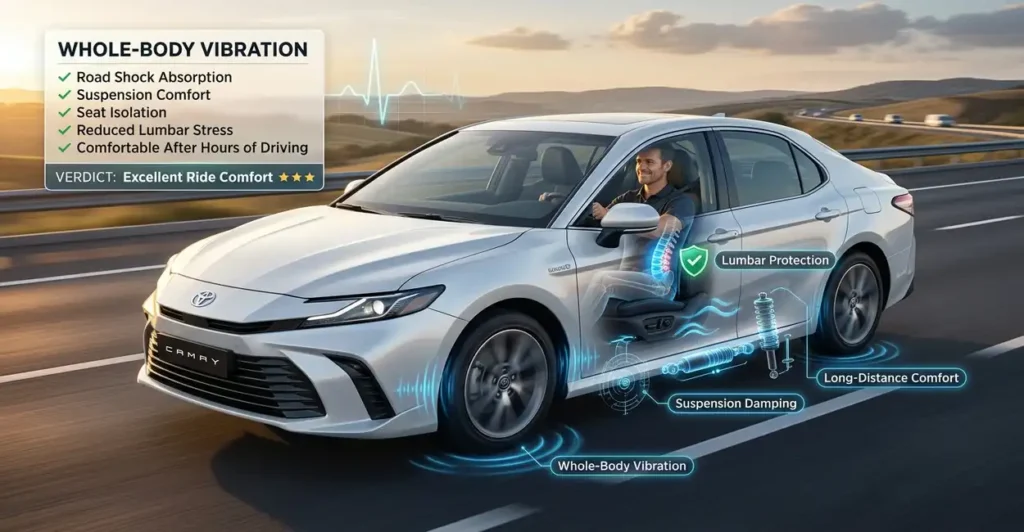
Whole-body vibration is one of the most underrated contributors to driving-related back pain, and it is rarely mentioned in mainstream car reviews. Every bump, expansion joint, and pothole transmits a small mechanical load into the lumbar spine, and over a long drive those small loads add up. The Camry Hybrid’s suspension tuning does a genuinely good job of damping that vibration before it reaches the seat pan, which is part of why my back felt noticeably better after this drive than after equivalent trips in stiffer-riding sedans.
Cabin Ergonomics: Pedals, Steering Reach, and Driving Posture

Good posture in a car is not just about the seat. Pedal placement, steering wheel reach, and dashboard height all affect whether your spine stays neutral or slowly rounds forward over a long drive. The Camry Hybrid’s pedals sit close to in-line with the seat centerline rather than angled toward the transmission tunnel, which avoids the twisted hip position that causes so much of the low back and sciatic discomfort I see in patients who drive older sedans and hatchbacks.
My Personal Experience Driving the Toyota Camry Hybrid 2026 Through Uva Province
I want to be honest about where this review comes from, because I think it matters. I drove the Toyota Camry Hybrid 2026 from Badulla out toward the tea country roads near Ella, the kind of route with tight hairpin bends, sudden elevation changes, and pavement that shifts from smooth to badly patched within a few hundred meters. That is a demanding environment for any car’s ergonomics, and it is close to what a lot of my patients deal with on their daily commute.
By the time I reached the return leg, I expected the familiar ache across my lower back that shows up after a long day of clinic work followed by driving. It did not happen. I noticed my shoulders were more relaxed than usual, and when I got out of the car, I did not need the usual thirty seconds of stretching before I could stand upright comfortably. That is not a scientific measurement, but after years of testing cars for this exact issue, I trust that kind of subjective data point almost as much as the numbers.
Who Should Buy the Toyota Camry Hybrid 2026 for Back Pain (and Who Shouldn’t)
The Toyota Camry Hybrid 2026 is a strong choice if you spend long hours commuting or driving between clinics, offices, or job sites, and if you deal with mild to moderate mechanical low back pain that responds well to postural support. It is a weaker choice if you have significant hip or knee osteoarthritis, since the low sedan ride height makes entry and exit more demanding than an SUV like the Honda CR-V or Toyota RAV4. If your main concern is a long annual road trip rather than a daily commute, pair this review with our guide to road trip DVT prevention before you travel.
Toyota Camry Hybrid 2026 Health Review: Final MD Verdict
After a full week of clinical use and a demanding mountain-road test, my verdict on the Toyota Camry Hybrid 2026 is straightforward: this is one of the better mainstream sedans currently available for drivers managing chronic back pain, and it earns its place near the top of our 50 Best Cars for Back Pain ranking. The lumbar support is genuinely adjustable rather than cosmetic, the suspension isolates road vibration well, and the hybrid powertrain’s smoothness removes a surprising amount of low-level muscular tension during traffic. Toyota’s own 2026 Camry specifications confirm the trim-by-trim seat and drivetrain details referenced in this review, and Consumer Reports’ Camry Hybrid overview backs up what I found on reliability and road manners.
Frequently Asked Questions About the Toyota Camry Hybrid 2026
Is the Toyota Camry Hybrid 2026 good for back pain?
Yes. The Toyota Camry Hybrid 2026 offers adjustable lumbar support, a well-damped ride, and pedal ergonomics that keep the hips and spine in a neutral position, which makes it a strong option for drivers managing mild to moderate mechanical low back pain.
How does the Toyota Camry Hybrid 2026 compare to the Honda CR-V for comfort?
The Camry Hybrid scores slightly higher on vibration isolation and long-drive fatigue, while the Honda CR-V scores higher on entry and exit height. Choose the Camry Hybrid for highway commuting comfort, and the CR-V if you need an easier climb in and out of the vehicle.
Does prolonged sitting in any car make back pain worse?
Yes, prolonged static sitting increases pressure on the lumbar discs regardless of vehicle, which is why the Mayo Clinic recommends breaking up long stretches of sitting with short standing or walking breaks, even in a well-designed seat like the Camry Hybrid’s.
Reviewed by Dr. Nirosh, MBBS, using the MD Comfort Score™ framework. This review reflects a personal test drive and clinical assessment and is not a substitute for individual medical advice.